Sunday, March 24, 2013

HAPPY WATER


How do you measure the wealth or well being of a country? Traditionally, economists only used the one thing they have been taught to study—money. Basically, what is a country’s Gross Domestic Product (GDP) or Gross National Income (GNI) per capita? Well, today, a popular measure is the Human Development Index (HDI) which had its foundations laid by Mahbub ul Haq in 1990 when he gathered a group of development economists to create a new measure of well-being to shift development economics from income-centered policies to people-centered policies.  Though Amartya Sen was initially reluctant to join in the work for fear of the impossibility of reducing the complexity of human capabilities down to a single number or index, it was Dr. Sen’s economic work that laid the groundwork to develop the index. Today, the HDI has three dimensions—a life expectancy dimension, an education dimension, and an income dimension. That was in the 1990’s.
 Backtrack to the 1970’s. Bhutan, a small Asian country bordering China, northeast of India and east of Nepal, decided that national happiness is much more important and crucial than national income. So they adopted the goal of achieving a high Gross National Happiness (GNH). Though it’s been criticized, and it’s extremely hard to measure within a country as well as comparatively with another country, it highlights the growing importance of happiness to people around the world who formerly did not consider it.

And that leads us to this.


International Day of Happiness


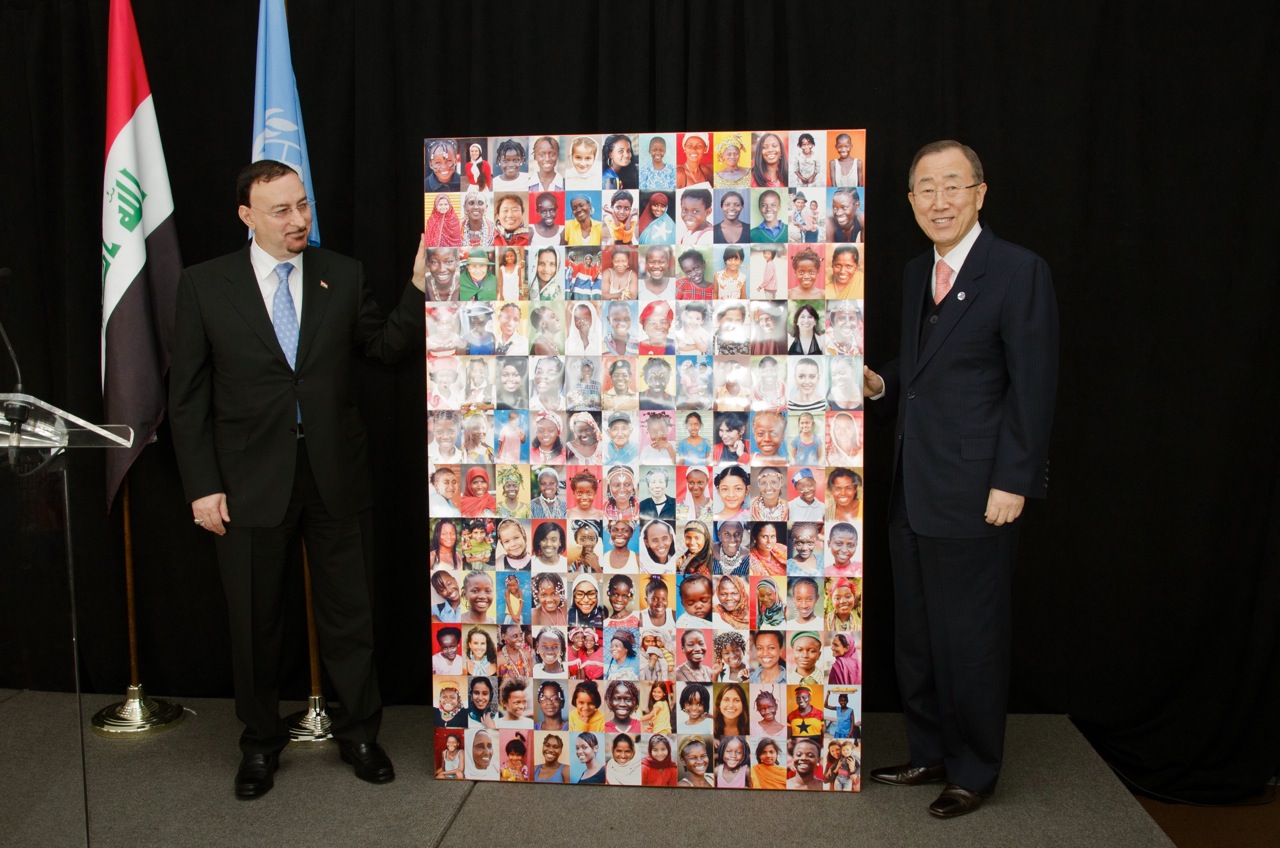
I know, I know. There are so many official and unofficial international days, international weeks, international years, and international decades. Why do we need another? In fact, there are people in a lot of countries who don’t even know these days happen. I don’t know if we need another, but I am glad to take time out from my day, week, month, and year and remind myself of the importance of joy (and happiness) throughout my life, my family, my community, my country, and my world. Apparently, the UN does, too, because Secretary-General Ban Ki-moon and the UN celebrated March 20th of 2013 as the first ever International Day of Happiness. Ban said he was “encouraged by the efforts of some governments to design policies based on comprehensive well-being indicators,” and he encouraged others to do the same. “On this first International Day of Happiness, let us reinforce our commitment to inclusive and sustainable human development and renew our pledge to help others.”

And helping others reminds me of today.

World Water Day


One way you can try to do something in your life, community, country, or world is by supporting World Water Day, the 22nd of March, this year, today. It’s hard to describe or explain how water is so important if it’s not experienced or felt. But each year we move closer and closer to water anxieties, and there are already regions in the world that are water scarce in which people suffer from dehydration and food dies due to water scarcity. Compound that with the problem of using water faster than the hydrological cycle recharges the water or the many problems of managing water rights across regions, borders, and countries, and then you see the problem is growing.

There are many ways to help. You can work on your own water footprint—all of the water that you use directly (drinking, flushing, washing, etc.) and all of the water you use indirectly through products you buy (water used to make the food you order, to take care of the animals used to provide you food, to wash equipment in the factory that produced your bag of chips, etc.). You can try to use less water and conserve water more. You can try to be more efficient with your water and waste less. You can also give back to organisations like Charity:water, Waves for Water, Water.org, etc. Or you can buy toilet paper from the social enterprise Whogivesacrap.com. Water scarcity affects over 2.7 billion people for at least 1 month each year. And you can help to decrease water insecurity for at least one person in the world.

THE NON-PROFIT DISADVANTAGE


Now if you’re someone who doesn’t want to donate money to a water-based non-profit because you think they are wasteful, have too much overhead, pay their employees too much, or are not really innovative, let’s start talking.

I’ve talked a lot about social enterprises that have revenue-generating models. But even the social enterprises with revenue-generating models still fundraise. And fundraising is what non-profits do. So today, I want to talk about the disadvantage that non-profits face because of the different standards applied to for-profits and non-profits.

I’ve been bothered a lot lately by the fact that there is no multi-national, global, big-money social enterprise. When you think of big companies you think of Apple, Samsung, Coca-Cola, GM, GE, Shell, Chevron, Wal-Mart, BP, etc. But I can’t think of one non-profit company or one social enterprise that size. Some say, it’s fundamentally and inherently an impossibility. Why it bothers me is that I think of all the amazingly impacting change a multi-billion dollar social enterprise could do—one that was still amazingly innovative in selling its products but just as innovative in using its profits for seeable change and whose products themselves were changing the world for those without access to basic needs. I’m still pondering this and what it would mean if it existed and if it’s possible to exist.

I do know that non-profits, today, are often hindered in their growth due to concerns of giving to non-profits, efficacy, efficiency, and waste. So I want to list the disadvantages they face in their work compared to for-profits and for-profit work. These disadvantages are highlighted by fundraiser and activist Dan Pallotta in his recent TED talk, The Way We Think About Charity Is Dead Wrong.


      1) COMPENSATION: It’s ok for for-profit leaders to make tons of money, but we do not like it when non-profit leaders make a lot of money. People don’t care so much if someone makes a lot of money selling violent video games, but they get very angry when a non-profit leader makes a lot of money. The problem is that for-profit sector then has an advantage because they can use compensation and salary to attract talent whereas the non-profit sector cannot. Dan gives a beautiful example where he takes the median compensation (with bonus) of a Stanford MBA holder at age 38 ($400,000) compared to the average salary of the CEO of a hunger non-profit ($84,000). It may not be greed that entices a person to take the $400,000 job., according to Dan. It can be much smarter to (1) take the $400,000 job, (2) donate $100,000 every year to the hunger charity, (3) save $50,000 on taxes (still $270,000 ahead of the hunger charity CEO), (4) be called a philanthropist for the $100,000 donation, (5) sit on the board of the hunger charity, (6) supervise the poor person who decided to become the CEO of the hunger charity, (7) and have a lifetime of this type of power and impact.

(Now, I have a slight problem with this thinking since I find it counter-productive, on one hand, to be part of a system that creates hunger and, on the other hand, sit on a board to fight it. However, the point that we need to be willing to compensate non-profit workers in general is an important one. At the very least, the extra attraction of higher salaries, allows people to live consistent lives “on both hands.”)


2) ADVERTISING: We’re ok with for-profits spending as much as possible on advertising, but we don’t like our donations to non-profits to go to their advertising needs. This reminds me of criticism heaped upon Invisible Children. What’s interesting here is that for-profits use advertising to increase revenues.  In the same way, a non-profit can actually increase the amount of money they bring in and fundraise, and therefore increase the good they do and the amount of money directly impacting beneficiaries through advertising.
  
      3) RISK TAKING: We’re ok with for-profits taking risks to generate potential new revenues such as new products (Apple) or new, daring movies (Disney). But when a non-profit takes a risk with a fund-raiser that doesn’t produce huge profits, they get in trouble and their reputation is hurt. Non-profits then become scared to take risks. The problem is that prohibiting failure kills innovation, which prevents the possible growth of revenue and stifles an organization or industry.

      4) TIME: We’re ok with for-profits taking time to get a return on investment (Amazon took 6 years before it generated profits). But if a non-profit needed 6 years of work before generating any return that benefited the hungry, people would critique the non-profit out of business.

      5) PROFIT: For-profit companies can pay out profits that can attract capital for investment into new risks and new ideas, but non-profits can’t pay profits, which reduces their risk capital, idea capital, and potentially their growth potential.

I’m not sure if these things will change, but I am happy that through social sector enterprises combining the social aims of non-profits with the for-profit revenue-generating models, that at least 5 is being addressed. However, it’s still a problem with non-profits. I know people criticise Jeffrey Sachs a lot, but often, I do understand what he means, that we honestly have not given much money (percentage-wise) to the problems we want to resolve. So I often wonder what would a world look like where a multibillion-dollar-profit-making company was a social enterprise and was so innovative in its products that it always remained on top. How would their profits go to social use and would it make a difference? My guess is that its products would become socially good if it was the ethos of the company. But is it possible?

I’ll leave the topic alone and invite you to comment and respond to it. Do you agree with the list? Do you see any possible solutions? Any new ideas bubbling beneath your hoods?

BLENDED LEARNING & EDUCATION


One non-profit doing interesting work is Matchbook Learning. The reason they stick out to me is simple. Throughout my life, I have seen people and programmes reward students who perform the best, like merit-based scholarships. I’ve seen programmes for students who are not in the top15% but quite close. I’ve even seen programmes for B and C students. But I don’t know of any regional or national programmes designed to take care and help and fund the education of the students who are performing the worst. (Incidentally, I see the same problem within my company as we decide in which countries we want to do outreach.)


But what I love is that Matchbook Learning works with the bottom 5% of schools (turnaround schools) in the U.S. using government funding for turnaround schools. You should watch the TEDxUNC talk: The Future of Education. Matchbook Learning Founder and CEO Sajan George tells how he uses technology-infused, mastery-based, data-driven blended learning founded in excellent teachers to turn schools around. I love how he left his job turning around failing companies and, wanting to have a bigger impact, decided to work on turning around failing schools.


His talk reminds me a bit of what some schools and school districts are doing with Khan Academy. Khan Academy now has an entire state using them for middle school math support. A 4-member, schools-implementation team from Khan Academy led a 2-day Khan Academy workshop for Idaho educators in October 2012 funded by the J.A. and Kathryn Albertson Foundation, an Idaho-based foundation that focuses on the expansion of excellent and limitless education for all Idahoans. The Albertson Foundation initiated a request-for-proposals to all types of Idaho schools (private, traditional, charter, alternative, after-school) to receive funding to pilot Khan Academy in the 2013-2014 school year. The grant winners were announced the 28th of February 2013 and the pilots will start in this autumn. You can watch a video about how Khan Academy was a saving grace for the educational work of the Albertson Foundation and check out the reaction of teachers at an education conference with Sal Khan in Boise in May 2012.


ART


Since we’ve been talking about social work, non-profit effectiveness, and education, I want to mention a related movie. I love documentaries because they highlight real problems using real people to tell their stories. However, some people don’t enjoy documentaries, and some don’t watch them.


So even though Waiting for Superman is an eye-opening documentary about the plight of education in urban settings in America today and the lack of equal opportunity to excellent education for every child, whether suburban, urban, or rural, there is another option—a fictional one. Check out the movie Won’t Back Down. It has a wonderful website with a toolkit to allow you to work on the issues once you’ve viewed the movie, spread the word, and work to change the system.

If you do like documentaries, you can watch the Waiting for Superman movie or just watch the trailer.

However if you like fictional ways of exploring such important issues and recognize the sometimes greater ability of fiction to tell a story and speak to people, check out the Won’t Back Down movie trailer and website. Go out and watch the movie if you can.

Friday, March 22, 2013

Google Reader Alternatives

As most of you know, Google Reader will shut down by the 1st of July, 2013. If you use Google Reader to follow me or any of your other friends, you may want to think about alternatives in the next 3 months. There are a number of other great RSS feed services that actually allow you to import your Google Reader subscriptions. Here are a few free ones I know.


Feedly - Feedly is probably the most popular RSS feed service in my community of friends. It features various web sites for your perusal and has a "Save for Later" function and a history feature to see what you've recently read.

Bloglovin - This is a nice news feeder service that is clean and intuitive to use (at least for me). It's free and features different blogs and posts to entice you to take a look. It has an iPhone app, but I don't believe it has an Android app at the moment. Here's an example lifestyle blog I was reading today on Bloglovin, The Londoner.

The Old Reader - If you want to go old school, love simplicity without a lot of distractions, and don't need a reader for your phone, you've come to the right place.

Taptu - Taptu lets you customise your feeds to get it just right for you. It has a lot of news feeds and sites listed by category to help you find what you may want to subscribe, too.

Pulse - This is nice for first time users because it's simple (and slick). You can swipe horizontally or vertically and you can personalize your home screen.


If you're ok with mobile-only RSS services with no web-based component, you can try Google Currents or Flipboard, both free.

Sunday, March 3, 2013

Follow the Frog

I'm reading a book called The Plundered Planet by Paul Collier, and it talks about reconciling prosperity and nature and if it's possible to develop in a way that benefits both nature and prosperity. And I ran across this video called Follow the Frog from the Rainforest Alliance. Deciding whether you like the campaign is up to you. Though I know the fees paid to fair-trade certification bodies can divert money away from farmers (as in the chocolate industry), I thought the video was quite funny and shows some of the things, issues, causes, and concerns we deal with in development, human rights, international trade, direct trade, and fair trade.