Showing posts with label art. Show all posts

Saturday, August 3, 2013

ART

I just want to mention the first feature-length film to come out of Saudi Arabia, Wadjda. If you have a chance to go see it, please do. Sure it doesn’t deal with the issues of the royal family and any authoritarian rule. And it doesn’t, likewise, directly comment on issues in Western societies, but it’s an interesting story and a beautiful tale of a girl who wants something and is in in a society that does not allow it.


Wadjda Official Trailer from Razor Film on Vimeo.

Sunday, January 20, 2013

ART


Enjoy this Week in Wildlife. The pictures are beautiful!


Monday, August 27, 2012

ITALY—ART

The Coloseum at Night

The Coloseum during the day

View looking down from the top of St. Peter's Basilica

View from my Sienna window

View at night from walk near my Sienna window

The art in Italy is another level. Even in one city like Florence, the heart of the Renaissance, it is like taking multiple world-class art galleries like the British Museum or the New York Metropolitan Museum and putting them in one city. Granted, some of these museums are smaller than the giant London museums, but it’s staggering to see the level of curating and the worth of the pieces, and in so many museums! In Italy, the museums themselves are art pieces. Ornate art pieces hang in ornately designed buildings that are architecturally beautiful and fading with artistically pleasing interiors. It is common to find artwork on the ceilings or upper rims of the wall of museums so that some museums (like the Uffizi in Florence) give you plagues to describe all that you might miss above you.

Even the Vatican was a big museum. I thought they allow you to go to the Vatican and see the offices and library. They didn’t. Or maybe they do, and I didn’t understand how to access it. Instead I saw the Vatican museum that did include former offices and housing of the popes. And yes, it includes the Sistine Chapel with Michaelangelo’s famous ceiling painting including the “Finger of God.” I thought it might be over-hyped, but it was very impressive. I wish we could have gotten closer to the ceiling but it was still impressive just looking up. Michaelangelo was commissioned to paint this ceiling by Pope Julius II who had promised a commission of 40 statues for his tomb and Michaelangelo thought that Pope Julius II might finally stop stalling if he did this. What is amazing about it that Michaelangelo considered himself a sculptor and preferred working with stone rather than paint. Michaelangelo had to learn the difficult and masterful technique of buon fresco in order to do the ceiling. On top of that, he had to learn perspective techniques that would allow him to paint on curved surfaces and still have the figures look correct from 60 feet below. All in all, I was quite amazed. With over 5,000 feet of frescos, it took over 4 years. Though it should have taken less (there were some initial mistakes learning the new techniques but the bulk of lost time was due to Pope Julius II being ill near death or out waging war) it is a marvel to look at visually and historically.

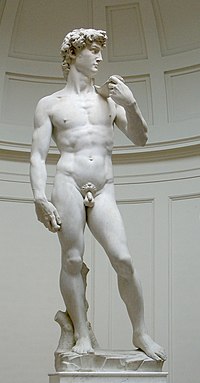
The art pieces in Italy are a bit like that. There is the piece, but then there is the history behind the piece, the work and sweat that comes through the piece, and the beauty embedded deep within the piece. Sometimes you can visit a piece, like the Mona Lisa in the Louvre, and you say to yourself “Is that it? Is this what all the hype is about?” It’s small and not particularly conspicuous. I think it may be more famous because of the question over the identity of the model. However, there are critics who say it has to do with the ambiguity of the expression, the forms, its monumentality, and the atmospheric illusionism. However when you are in Florence and go to see Michaelangelo’s David, it’s staggering, I mean really. Yes, anatomically, it’s pretty good (though Michaelangelo is criticized for being over-muscly at times, it’s common for artists to sacrifice anatomy and nature for art), but the sheer size of it is overwhelming. You can see intricacies like veins. I can talk about the fusion of Greek art with Renaissance sensibilities but I won’t; it’s just nice to admire. As an engineer, what touched me the most was that the University of Bologna’s Civil and Environmental Engineering department had a machine set up and connected to the base of the statue from the back. They were studying and monitoring crack propagation through the statue. I thought that that was an amazing project for the engineers to involve themselves. I always remember people who studied crack propagation in my department. I never thought that some people would have the chance to apply it to the statue of David.


Most stunningly is that the city of Rome is a piece of art. Both Rome and Florence are set in the basin of seven hills. And as you walk the streets of Rome, all the buildings have the style of structure you associate with Spain like the Spanish tile roofs. You leisurely stroll on cobblestone paths through narrow passageways lit by a single lamp between burnt-Sienna brick walls with the smell of pesto and tomato sauce wafting in the air. You see a small restaurant with 3 tables in the street

and people taking in the lovely night air as they smile at you and stare. An accordion is playing in the street, and as you pass by you hear the accordionist say “Buona Sera” to which you say “Buona Sera.” As you walk past, the accordion music fades into the background as the rush of water grows in intensity and the narrow passageway opens into a beautiful piazza (think plaza or square) with a fountain in the middle in which water is gushing out of a beautiful statue of Triton and his mermaids. People mill about it making wishes, taking pictures, eating food. All around the square and fountain are open-air restaurants, music playing, and people watching

people. To one side you find an old, dark grey,
austere building with amazingly tall dark stone columns, still preserved, but with pieces missing and chunks of stone gone. The building is capped by dome with a hole in the center that takes in the last vestiges of dying light from a sunset that refuses to die quietly. You go inside and the light of the sunset shines through the whole in the top at a diagonal angle and rests on you as you survey the embellished, Renaissance-style architecture of the walls in near obscurity. You try to take photos but you can never quite capture what your eyes see, what your ears hear, what your skin feels . . . what your nose smells, what your taste buds crave, and what your tummy wants. Food.


ART


I’ve seen a lot of art this past month, and I wanted to just mention one interesting installation about books. It’s called aMazeMe. It is a literally maze of books that rises to 2.5 meters high and employs over 250,000 used, second-hand, and donated books over an area of 500 square meters. The maze is a tribute to the writer Jorge Borges and mimics the shape of his fingerprint. There was contemplative music playing while you walked through the maze and literary quotes that were projected onto a black screen at the back of the maze.

 You were allowed to take any book you wanted (from the top of each stack, of course) and sit down and read on the many couches and chairs surrounding the space. You were not allowed to carry any books away, however. So I enjoyed myself. They had books on cooking, babies, languages, fencing, science, history, biology, etc. Of course there were many fiction pieces and even books in Braille. There were new books and old books, books I had never heard of and classics. They had everything in that pile. I’m happy they are donating all the books to Oxfam since many are quite useful for education. Enjoy the pictures!


Monday, August 13, 2012

ART


 Like I said, I work for this smaller technology firm in the UK and they treat us really nicely. On the opening weekend of The Dark Knight Rises, the engineering part of the company rented out a theatre for all the engineers. Then because we didn’t fill it out we were able to bring a guest. We were each given a bottle of water and popcorn and I thoroughly enjoyed myself, having waited for this movie for over a year. I want to say that it is good. It has a lot of cool effects and action but a lot of drama. It’s slower than the 2nd movie, The Dark Knight, because the action doesn’t really start until maybe 2/3rds of the way into the film, but it’s quite good. I think I liked it because I like drama and there is a lot of drama, relational struggles, and personal searches.

I will not say that it is better than Batman 2: The Dark Knight. How do you beat that movie where the action starts from the beginning, where it ends and continues at least 3 times, and where Heath Ledger played his role to perfection? It’s hard. The Dark Knight Rises was still a good movie, and I loved the psychological parts the best. My two favourite thinking moments which I’m still trying to apply to my life were about hope and fear. One of the characters in the movie said “Without hope there is no despair.” . . . . Just sit and let that counterintuitive statement hit you. I LOVE IT! And I find it to be true. The second one was not completely worded as it was lived out—fear makes a man stronger (or more able). . . . how does that one hit you? I also find this to be true. I think Christopher Nolan not only did a great job directing, he did an excellent job co-writing it. I encourage you to go see if it you liked the first two.

But what really has me thinking is the movie Anonymous which advances one of a number of theories about the “true” identity of the writer, William Shakespeare. This is an old academic (some say nonsensical) debate that has gone on for decades, with the specific conspiracy theory in Anonymous first appearing around 90 years ago, advanced by a man named Thomas Looney.

First, to make sure you understand what I’m writing, I will call the actor from Stratford-upon-Avon who moved to London and became famous for many plays, eventually opening up and co-owning the Globe Theatre William of Stratford. I will call the actual writer (which could be the same person) William Shakespeare. Secondly, I’m always bothered by current media that presents two sides without giving me the proper context of what percentage of experts fall on each side or the fact that there are many more opinions other than the two extremes presented. So let me say that the vast majority of academic Shakespeare experts believe that William of Stratford is William Shakespeare. Thirdly, remember that even though a vast majority of people believe William of Stratford was Shakespeare, there are still academics who doubt it, even if in the minority. So it is not only conspiracy theorists or people who are not Shakespeare experts. Lastly, let me give you a few of the problems the people (in the minority) have preventing them from believing William of Stratford wrote the plays attributed to Shakespeare.

 William of Stratford had little or no education – Some believe that the level of knowledge and sophistication in Shakespeare’s poetry and writings required that he be an aristocrat or at least well-educated. However, the problem with this view is that Ben Jonson and Christopher Marlow (also in the movie) had similar backgrounds. Ben was the son of a bricklayer, I believe, while Marlow was the son of a shoemaker. Ben also had a grammar school education, and many people consider Jonson’s plays and Marlow’s plays even more educated or erudite. The point here is that it is hard to understand, but it is impossible? No one disputes Jonson’s authorship nor Marlow’s authorship. I will, however, say that there is a reason that Shakespeare is considered the greatest of all time.

William of Stratford’s children were illiterate – I think the belief is that someone that well-written and educated (whether self-educated or otherwise) would have educated his children or had his children educated. This however deals with probabilities as opposed to proof.

William of Stratford never left any writing in his own handwriting other than 6 signatures (which differ in spelling) - This one actually bothers me. Of course, I say this from 21st century experience in which I know if I died, people would find many things both typed by me and written by hand by me. I still find it odd that there is no writing in his handwriting. The first folio (first publication) of his work was completed in 1623 by two actors in his company after his death. It sits here in the UK at Oxford University. Again, this is not proof, but raises doubts.

William of Stratford spent a lot of time engaging in law suits  - This one makes me laugh. The problem here is one of time. If you look at any of Shakespeare’s 37 plays, they seem to have taken a long time to write. Where did William of Stratford get the time to write such plays when he had a wife and children and was spending time and effort engaging in law suits? Again it makes me laugh, and seems like a logical question. Interestingly enough, you can see legal experience in Shakespeare’s plays like the Merchant of Venice.

William of Stratford couldn’t read French, Spanish, or Italian – Shakespeare’s plays show a knowledge of these languages (including references) or at least access to translated versions. But there seems to be no evidence that William of Stratford could read any of the languages or had access to translations. The problem here, again, is that though it’s hard to believe, we just don’t know if he actually did have access to a privately circulating translation or if there was a translation that is no longer with us today (this has happened with other texts that we know about).

William of Stratford never traveled outside of London (after moving there) – We have no record of him traveling outside of London but he could have done so unknown to us today.
William of Stratford left no books, letters, or correspondences in hi will and did not get even one eulogy at his death – This is another of those strange things. If I were William, again from my limited 21st century perspective, I would have books and letters and correspondences that I owned. I would at the least have books that I owned if I loved to write so (and possibly read and borrow and create history plays). And many find it strange that he died somewhat unnoticed. To be honest, I don’t really get it myself.

I read one analysis that said to name one, just one other writer who was illiterate, brought up illiterate children, financed his work from the pockets of common people, has a name that is a pun, has a name that states a sentence in English, died unnoticed, and never commented on the events of his day. The last point is another reason people think someone else (the Earl of Oxford) was the writer because they felt the Earl of Oxford had a reason, being aristocracy, not to directly comment on other aristocracy and the events of his day.

However as much sense as it seems to make that William of Stratford and Shakespeare were two different people, it’s hard to find proof of it. In support of William of Stratford, I find it strange that I have read nothing from the time of the Shakespeare including immediately after his death that proposes hypotheses of alternative writers. This is all more recent history. Some believe this is because it was a great cover-up or conspiracy to hide it. If so, it was very well done. If you want to convince the academic establishment (including people who have spent their lives studying this) you have to find some actual direct proof to link Shakespeare’s plays to someone else instead of starting with the holes or problems with the authorship belonging to William of Stratford. Still it’s a tantalizing mystery. In reality, though, it doesn’t really matter who wrote it. I’m just thankful we have the plays and can enjoy them for what they are worth (or not worth if you don’t like Shakespeare).

I went to the Tate Modern museum recently and saw an exhibition by Sung Hwan Kim in the Tanks section of the Tate. I went there with James, a college friend and DC male a capella group-member. We were going to support the work since another college associate did the music for Sung’s exhibition. I must tell you that I was so disturbed by that exhibition. It literally unsettled me like watching a suspense or horror film. I kept thinking why. Sung is an interdisciplinary artist, so he uses narration, video, images, music, sound, sculpture, and more. And I thought to myself, that sound and music was a huge reason why it reached me more than it would have without it. That seems obvious, but I wonder if all art is not equal to me.

It seems much harder for a visual art piece to reach out and grab me the way a piece of music has the potential to do with no visual aid. Yet, if the art piece is combined with music it regains that potential. I’m not sure if I’m imagining this but it seems that way. I can look at art pieces (I spent a lot of time in Italy in museums) and be moved but it seems much rarer that a piece really moves me or shakes me than a piece of music moves or shakes or shapes me. I wonder if I am more susceptible to mood creation through my auditory cortex rather than my visual cortex. I don’t know. Does anyone else experience this? Let me know. Until next time, ciao.

Sunday, February 12, 2012

ART - Movies

I haven’t gotten out much yet since moving. But due to traveling some, I’ve seen a few movies on the plane and a few in town.


Haywire – With this movie I was just happy that they had a leading actress who was not stereotypically model-skinny. I appreciate that and want more role models of a more typical size.

Like Crazy – I really liked this independent film. I hated (and knew) that it was one of those film where they don’t let you see what happens in the end. I have my opinions about if the relationship will last (due to certain signs throughout the movie). I you cannot relate to the situation of the couple in the film, go watch it. If you can relate to it or the situation is still emotionally close to you, don’t watch it. It’s sad.

Stupid Crazy Love – Again, for some reason this one and Like Crazy really got to me. But it’s a much better romantic comedy than the formulaic ones (there were a few moments that didn’t seem realistic). This one also doesn’t tell you what happens in the end and leaves it up to your imagination. I like that, but I’m not all that used to it.

The Town – This was an interesting film which explores the story we tell ourselves about ourselves. I think I might write a post about it in the future. I enjoyed it. It’s quite a sad film to me about a Massachusetts town that has produced the most bank robbers in the U.S.

Sunday, August 28, 2011

ART & LIFE

There’s a jazz vocalist I like name Gretchen Parloto. I actually didn’t know she was that big, that the accolades around her were quite high, that her stylings are so laudable. But she’s good and she sings like. . . another instrument in the band somewhat. Funny, I heard her say in an interview that if she could croon like Chaka Kahn or Aretha she would. She said she tried it and it doesn’t sound pretty; no one would want to hear her (I laughed at this). So she does what she’s good at, and boy is she good at it. It’s an understated sound and singing so it may not be for everyone, but I wanted to mention her since I was listening to her recently.

The other reason I like her is that she teaches and does workshops. I think this is the greatest thing an artist can do. It’s that connective link that’s so important. There’s more. When she’s passing on what she does or trying to give a workshop, it’s very important to her that it’s more than just the music, more than just working on or learning about rhythm, phrasing, interpretation, and improvisation. She wants to drink tea, talk about who you are and why you’re doing what you’re doing. She wants to know where you are going. She wants to also work or tap into the emotional and spiritual side of music and release its potential to transform both the artist and those that are listening.

The other artist I’ve been listening to is Bobby McFerrin. I’m not sure what to say about him. I actually view him as a gift to the world and the type of artist that doesn’t come along very often. I have been recently rediscovering him, again. I’m especially amazed by him because he treats the voice in a similar way to the fashion an instrumentalists treats her instrument. Normally in music, we use the term singers to denote someone who sings but isn’t a musician. Vocalist is carries much more connotations of musicality with it. But in all honesty, even if you are a vocalist, you get by with less. You can practice less than a non-voice instrumentalist. You just learn your notes (way faster than it takes for instrumentalists to learn theirs which actually deals with physically moving the hands, feet, and body fast enough and with dexterity and agility in order to play it technically correct). Bobby sings songs that vocalists don’t normally do. For instance, my FIRST interaction with Bobby was to sing “Flight of the Bumblebee” for my senior recital in high school. I did it as a duet with a cellist, just as Bobby did it as a duet with Yo-yo Ma whom I love (Yo-yo is so willing to improvise and play with anyone to create beautiful music). Vocalists don’t sing Flight of the Bumblebee. It’s too. . .technical. It’s just a bit crazy to do that. But he did it, so I did it. Bobby will also sing arpeggiated accompaniment to a song like Ave Maria exploiting the range of the human male voice. No one did that before him (I haven’t really heard anyone do it after him). It’s hard to do that and play your voice like an instrumentalist but he did it and does it.

His intonation and accuracy, his ability to shift between his full-voice register and his falsetto and head voice at a moment’s notice is unparalleled. He jumps back and forth between them with ease and not only is able to do that with learned songs, but he can do it while improvising. This is quite . . . amazing. He is able to really go on and on and on improvising which is important for vocalists to learn—not to stop, keep going. Anyway, can you tell I like him and his work. Once Bobby came and did a workshop with my choir, and Bobby actually said “God is in the music.” Literally, God is in the music.

Smile


Improvisational duet - Lullaby of Birdland


Centerpieces


ART


Someone asked me what books I’m currently reading and wanted me to talk about them in this section.

Religious Studies
Finding Our Way Again by Brian McLaren
A New Kind of Christianity by Brian McLaren
Prodigal God by Tim Keller
How (Not) To Speak Of God by Peter Rollins
Fidelity of Betrayal by Peter Rollins
Orthodox Heretic and Other Impossible Tales by Peter Rollins
Mere Christianity by C. S. Lewis

Social Justice
Christianity and the Crisis in the 21st Century edited by Paul Raushenbash

Negotiations & Social Science
Influencer: The Power to Change Anything by Kerry Patterson, Joseph Grenny, David Maxfield, Ron McMillan, Al Switzler
Getting to Yes: Negotiating Agreement Without Giving In, 2nd ediction, by Roger Fisher, William L. Ury, Bruce Patton (editor in 1st edition)


History
Africa in History by Basil Davidson

Economics, International Development
Wars, Guns, and Votes by Paul Collier
Dead Aid by Dambisa Moyo

Fiction
The Brief Wondrous Life of Oscar Wao by Juno Diaz


But more than that, I wanted you take a few minutes and look at a few photos from the White House Photography Exhibit. I love photography.


Presidential Photography
Domestic News Photography
Story & Politics Photography

Sunday, August 1, 2010

NATURAL LIFE

It’s always interesting to me to see how people see you. I have heard from two girls who have stayed at our house recently in the past 6 months that they think that I feel they are not intelligent or on par or smart. What’s funny about that is that they’re implying I see myself as smart. Anyone who knows me really well (this is a test) knows I don’t see myself as smart inasmuch as it is a naturally innate distinguishing characteristic. If you mean smart in that I learned something in school that many others didn’t study or learn or I gathered some capability through that learning, then yes. But time and time again, I become assured and reassured that the large differences in intelligence between people are not innate and due to many outside influences such as environment and parents and schooling and neighborhood.

Art teachers have told me that all people can draw. All children draw at the same level. It’s only around 2nd grade or so where they start to diverge and some lose the ability to see things in the proper way to draw or maybe the others gain it.

Drama teachers have told me that all people can act. All children can act, and at a certain age we begin to diverge where someone retain this ability and others lose it or stop exercising that part of the mind.

Intelligence like reading seems to be learned. Remember that we gravitate to things that make us feel like a loser. My cousin’s son was not a good reader. He struggled, but my cousin-in-law (my cousin’s wife) worked on reading with him. . . . Hard. She forced him to sit down and practice and practice and practice. He HATED it. But she got through it. Now he’s an excellent reader, and guess what. He LOVES it! You can’t stop him from reading. My cousin, the husband, said that he wished someone had done that with him. To this day, it affected him and he doesn’t like to read. He thought it was innate, some are good readers and some are not. Ha!

This pattern I’ve seen again and again. I’ve seen it with learning languages (there are many ways to learn languages by the way, not just the traditional translational approach in classes). I’ve seen it with mathematics. I’ve seen it with science. I’ve seen it everywhere. The biggest proof to me was teaching middle and high school. The kids were merely differentiated not by ability but by wholes in knowledge that persisted and were never cleared up. I have never had a not even one student who had mastered all previous pre-requisite classes leading to this one and had mastered every lesson this year before today who misunderstood and could not learn the material for today. It’s cumulative. Some get so far behind, aren’t encouraged or strengthened or pushed or taught---and we grow up thinking there is a difference.

Now something my art teacher told me is that it doesn’t mean that we’ll all be Rembrandts. She can only teach people to see so that they draw well. It won’t make you a Picasso but it will allow you to bring out the artist in you, the scientist in you, the nurse or accountant or brain surgeon (or whatever you find hard) in you.

So it’s interesting how this notion of differences that are insurmountable and innate affect how people see each other. It reminded me, when listening to these two girls about the heart of a girl, the heart of a woman.