Showing posts with label Italy. Show all posts

Saturday, January 12, 2013

ITALY


I haven’t seen many Italian movies, though. I decided I would also add a few more observations about Italy given that I visited it for a second time in 2012 because I didn’t get to see everything the first time. This time I went to the northeast and saw towns like Verona and Venice, the Disneyland of canal cities. Verona was funny because there was a house claiming to be Juliet’s house (Romeo and Juliet) and it had the famous balcony from which Juliet called out “Romeo, Romeo, wherefore art thou Romeo?” There is a bronze statue of someone that is supposed to be the fictional Juliet and visitors come far and wide to place one hand on her colour-changing breast (due to the oils in people’s hands) and take a picture in that pose. It’s strange but that’s what they do.

Venice is a bit hard to describe. It really is like people tell you. There is a type of romance there, a stink there (though I didn’t smell it), a beauty there, a mystery there, and a resilience there. There really are gondolas, though they may look slightly different than you imagine. The gondola drivers don’t actually sing, but you can hire a separate opera singer to go on your gondola and sing while you float about in the Venetian canal-ways.


I wanted to share some observations, though, about the country, different from what I shared last time. The first is that there is a lot of city and regional pride in Italy. I mean people in Venice are Venetians, first, and Italians, second. That might be unfair since Venice was an actual republic before whereas other Italian cities were not. But there is definitely a regional pride in specific, regional recipes, foods, discoveries, languages, and dialects. Different cities claim to have the best pasta. “Every” city claim to have the best gelato.

The second observation is that Italy has a type of Eastern European feel. I’m not sure what I mean by that but it is poorer than France, Germany, and England. It seems to have that type of rural communal feel, of families getting together and sharing what they have, of people living their dreams, if only in their hands, but speaking it into imaginative existence. There is drama here in the simple things as if they were fantastical. And an intersection in which four cars meet can become the climax of a movie with people getting out of their cars doing various gestures (it doesn’t occur to any of them to back up). A woman might pass you in the street railing against the government as if she had no power, no voice, no ability to affect the change. It’s dazzling, simple, and strange.

The third observation is that the people there don’t care so much about appearance related to swimwear. Women in North America tend to hate men’s bikinis (often called speedos). I’ve been told this is not a cultural experience; women just don’t like seeing that. When you go to some Asian or European countries it’s quite the opposite: no one cares. It’s just normal. So now I believe it is a cultural thing with North America and the love of board shorts or trunks. If a woman grows up in a culture where men and even boys at a young age wear boys bikinis or speedos, then the woman is more likely not to care and to be used to it instead of grossed out like North American women. It was interesting to see. In Italy, I stuck out for wearing swimming trunks. It also works the other way. In North America, if a really large woman wore a bikini, a friend would tap me on the shoulder and say “No she didn’t!” In Italy, when it’s hot outside, a really large woman puts on a bikini because that’s what you do. No one says “What is she doing?” or “She looks ridiculous.” I guess it’s just normal. And I don’t mean just big women, I also mean big elderly women. I also expected bikinis to be a swimsuit that the young would wear, but I often saw elder women wearing bikinis, too. It seems to be more natural there. And more people seem not to care.

Monday, August 27, 2012

ITALY – CULTURE


So I went on a trip to Italy and met with Bianca there. Some missionaries she knew in Rome hosted us. It was a pretty nice trip, and I could write for days on it. Instead I’ll give you a link to a blog on Italy that sums up our trip. I left for the trip on my birthday. So it was a nice present of sorts. I never imagined or thought of going to Italy, honestly. Most of my trips or travels are service-style trips to developing countries. The funny thing about Italy is that it’s considered a developed country but it has a kind of developing country feel or even a very small-country feel.

Traffic lanes are a suggestion and you can drive however you want.
Three cars can meet an cobblestone intersection with no lights or stop signs and the people will stick their heads out of the window and argue about who show move or back down. The entire walking population in the area stops and watches. This actually happened while I was in Rome.
People in Italy will yell, scream, argue, beg, and plead with customer service representatives when the service is poor or when they have been wronged in someway (complete opposite of the UK). People speak with their hands a lot. A lot. It’s interesting.
There graffiti everywhere. Everywhere. It was hard to find a subway car or an aboveground train car that did not have graffiti on it.
There are lots of people hustling to give you a guided tour or hustling to give you a taxi ride.
And pickpockets are everywhere.

(If you watch Burn Notice, I’m about to do one of those Burn Notice-teaching moments) When you are being trained in certain industries, one thing you learn or know is that pickpockets use the art of distraction. For that reason, whenever I am bumped or there is pressure against me, I know I should be checking my pockets. The other technique I use a lot is to consciously “listen” for the feeling of my wallet against my leg. The brain receives millions of stimuli every second. The brain also uses a certain filtering mechanism, so you aren’t overwhelmed by an overload of information.

Even in the area of memory, sensory memory is the first level of memory, and nothing will be encoded into short-term memory unless something or someone calls your attention to something that you are sensing. If you stop and concentrate right now, you probably realise you can hear tons of things you didn’t realise you were hearing—the hum of the air conditioning unit, the rustle of leaves, the chirping of bids, the typing of the keyboard, some weird knocking sound in your pipes. So one technique I use is to tell my brain that the feeling of the wallet against my leg is important and I want to keep feeling it, focusing on it. This allows me to notice more quickly when it is gone or being moved.

Well, I’ve never been pick-pocketed so I’ve never had to worry about it if works, but in Rome, pick-pockets are everywhere, and on this particular day I was wearing cargo-shorts (khaki, short trousers/pants with the extra side pockets).a guy with a tight-fitting t-shirt, almost-bald head, large sunglasses, and dark blue new looking-jeans above white sneakers/trainers/tennis shoes was staring at me intently as I stood near the exit door of the bus. I believe this gave him a nice opportunity since he would have a reason to stand near the exit bus. So he came over and stood as if waiting to exit and he pushed against me. Now his push wasn’t unnatural. It felt like it was just a crowded spot; though you could always ask “Why didn’t he stand further away and wait until the bus came to a stop and then go towards the door?” That’s true, too. Anyway, when he was pushing against me, something told me “that’s pressure” so I just lightly put my hands over the opening of the right side pocket with my wallet and passport. I did not turn around and acknowledge anything as I was facing the left side of the bus talking to Bianca who was seated. He did also did not turn around and acknowledge anything as he was facing the right side of the bus with the exit door and carrying a jacket which he was using for covering. As soon as I put my hand to my side pocket, I felt his fingers trying to slowly and smoothly reach into my pocket. I remained calm and closed the pocket saying nothing. The bus stopped and he got off. It shook me, though; it really shook me. I was supposed to move closer to the front to the driver could tell me when my stop was but I missed the opportunity because I was still processing what happened. Bianca thought I was crazy just standing there. Then the next stop came and the driver was calling out and I was still in a daze, and then we realized this was our stop and we got off to go visit one of the ancient Roman catacombs that harboured Christians running from Roman persecution.


Usually, when in another country, the first thing I subconsciously try to do when talking to someone for information is find out which language to use. Which of us speaks the other person’s language better. However this was hard to do in Italy because no one admitted to speaking English well or even a fare amount of English. The answer to “Do you speak English” was always “no” or “a little bit.” So then you speak Italian to the person and she answers back in English. If you speak English, he answers back with better English than you. I’ve realized that they must have a high standard for speaking a language since no one speaks English. And then there were tourist places where people actually didn’t speak any English. So you had to speak Italian. I couldn’t believe it when one day, two women asked me to be an interpreter or intermediary between them and the bus driver because he didn’t speak English. It’s funny because I don’t really speak Italian but I know more Italian than the driver who didn’t speak any English. And it actually worked, I could get the point across. At one point the woman wanted me to ask what time we would arrive at her stop. I asked him but his answer didn’t make sense to me. The only thing I could think was to tell my brain to think. So that’s what I did. Slowly but surely, my brain began to register that he said something like 10:30 PM in a long drawn-out way. Thank goodness for similarities between Latin-based languages. The sad part about that day was that we were trying to catch a train into Tuscany to a town called Sienna (where the colour Burnt Sienna comes from). The train station announced that the train was canceled (all in Italian). Later we found out that a bus would come and take us to our stops. Then it turns out that a train did come, but because we were outside waiting for the bus, we had to run back in and try to catch it, but it left before we got to it in time. No apology from the train staff. We wait longer for the bus, and two of our group (two Italian women) get a ride from someone driving to Florence (Sienna is on the way to Florence). So the rest of the group is left. The train station staff do not seem to know when a bus is coming, or at times, if a bus is coming. We’re all a bit distressed because there are no more trains to our destination. Finally a bus arrives, and it takes probably 45 minutes to an hour to leave because the bus driver refuses to take 3 women and one child to Florence where the train was ultimately going. Whoever had called the bus didn’t give the bus orders to take all the people who were waiting for the train to all the stops the train was going to go. So the women were visibly and aurally upset, crying, yelling, screaming. The train station staff had all left by this time and there was no service even though there were still trains coming in and out of the station. Finally the bus driver called a bus company colleague to come down and explain to the women that the bus would not go to Florence; this was completely unfair. They finally got off the bus (they had refused before) crying and standing at the station as we left. I don’t know what happened to them, but I should have done something better to explain we would have paid for the bus to go to Florence if that was the issue especially since the train station promised we would all be taken to our destinations by bus.


My favourite part of the trip was spent in a group of five towns in the northwest Mediterranean coast of Italy. The towns are called Cinque Terre and each of the towns sits on a cliff overlooking the water. The towns range in size from 200 like the town we stayed in and 500 residents for the bigger more touristy towns and they are located in the Italian Riviera area, not as glitzy as the French Riviera but still quite beautiful. I loved these towns. It felt good to feel like a local and see the people and greet them each morning and night. The hiking was brilliant in these parts and the swimming, though quite cold, was a good way to cool down. Instead of sand beaches, though, they are mostly rock beaches. But I still enjoyed myself as I had not yet experienced summer in London. So this was a welcome vacation and warm respite from the cool, cool London. The weather made me wonder how the art would compare between the UK and Italy.
Locks hung by lovers, an Italian tradition


ITALY—ART

The Coloseum at Night

The Coloseum during the day

View looking down from the top of St. Peter's Basilica

View from my Sienna window

View at night from walk near my Sienna window

The art in Italy is another level. Even in one city like Florence, the heart of the Renaissance, it is like taking multiple world-class art galleries like the British Museum or the New York Metropolitan Museum and putting them in one city. Granted, some of these museums are smaller than the giant London museums, but it’s staggering to see the level of curating and the worth of the pieces, and in so many museums! In Italy, the museums themselves are art pieces. Ornate art pieces hang in ornately designed buildings that are architecturally beautiful and fading with artistically pleasing interiors. It is common to find artwork on the ceilings or upper rims of the wall of museums so that some museums (like the Uffizi in Florence) give you plagues to describe all that you might miss above you.

Even the Vatican was a big museum. I thought they allow you to go to the Vatican and see the offices and library. They didn’t. Or maybe they do, and I didn’t understand how to access it. Instead I saw the Vatican museum that did include former offices and housing of the popes. And yes, it includes the Sistine Chapel with Michaelangelo’s famous ceiling painting including the “Finger of God.” I thought it might be over-hyped, but it was very impressive. I wish we could have gotten closer to the ceiling but it was still impressive just looking up. Michaelangelo was commissioned to paint this ceiling by Pope Julius II who had promised a commission of 40 statues for his tomb and Michaelangelo thought that Pope Julius II might finally stop stalling if he did this. What is amazing about it that Michaelangelo considered himself a sculptor and preferred working with stone rather than paint. Michaelangelo had to learn the difficult and masterful technique of buon fresco in order to do the ceiling. On top of that, he had to learn perspective techniques that would allow him to paint on curved surfaces and still have the figures look correct from 60 feet below. All in all, I was quite amazed. With over 5,000 feet of frescos, it took over 4 years. Though it should have taken less (there were some initial mistakes learning the new techniques but the bulk of lost time was due to Pope Julius II being ill near death or out waging war) it is a marvel to look at visually and historically.

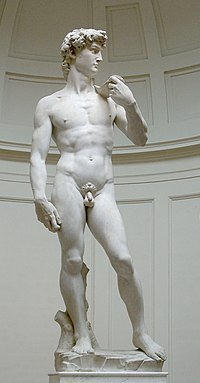
The art pieces in Italy are a bit like that. There is the piece, but then there is the history behind the piece, the work and sweat that comes through the piece, and the beauty embedded deep within the piece. Sometimes you can visit a piece, like the Mona Lisa in the Louvre, and you say to yourself “Is that it? Is this what all the hype is about?” It’s small and not particularly conspicuous. I think it may be more famous because of the question over the identity of the model. However, there are critics who say it has to do with the ambiguity of the expression, the forms, its monumentality, and the atmospheric illusionism. However when you are in Florence and go to see Michaelangelo’s David, it’s staggering, I mean really. Yes, anatomically, it’s pretty good (though Michaelangelo is criticized for being over-muscly at times, it’s common for artists to sacrifice anatomy and nature for art), but the sheer size of it is overwhelming. You can see intricacies like veins. I can talk about the fusion of Greek art with Renaissance sensibilities but I won’t; it’s just nice to admire. As an engineer, what touched me the most was that the University of Bologna’s Civil and Environmental Engineering department had a machine set up and connected to the base of the statue from the back. They were studying and monitoring crack propagation through the statue. I thought that that was an amazing project for the engineers to involve themselves. I always remember people who studied crack propagation in my department. I never thought that some people would have the chance to apply it to the statue of David.

Most stunningly is that the city of Rome is a piece of art. Both Rome and Florence are set in the basin of seven hills. And as you walk the streets of Rome, all the buildings have the style of structure you associate with Spain like the Spanish tile roofs. You leisurely stroll on cobblestone paths through narrow passageways lit by a single lamp between burnt-Sienna brick walls with the smell of pesto and tomato sauce wafting in the air. You see a small restaurant with 3 tables in the street

and people taking in the lovely night air as they smile at you and stare. An accordion is playing in the street, and as you pass by you hear the accordionist say “Buona Sera” to which you say “Buona Sera.” As you walk past, the accordion music fades into the background as the rush of water grows in intensity and the narrow passageway opens into a beautiful piazza (think plaza or square) with a fountain in the middle in which water is gushing out of a beautiful statue of Triton and his mermaids. People mill about it making wishes, taking pictures, eating food. All around the square and fountain are open-air restaurants, music playing, and people watching

people. To one side you find an old, dark grey,
austere building with amazingly tall dark stone columns, still preserved, but with pieces missing and chunks of stone gone. The building is capped by dome with a hole in the center that takes in the last vestiges of dying light from a sunset that refuses to die quietly. You go inside and the light of the sunset shines through the whole in the top at a diagonal angle and rests on you as you survey the embellished, Renaissance-style architecture of the walls in near obscurity. You try to take photos but you can never quite capture what your eyes see, what your ears hear, what your skin feels . . . what your nose smells, what your taste buds crave, and what your tummy wants. Food.


ITALY – FOOD


The food here is an art form, I’m sure of it. I didn’t realise this but many people come here for culinary tourism like in the Eat, Pray, Love book. Some people come to just eat and eat and eat. Others come to learn how to cook. You can travel to Italy and take cooking classes learning a specific cuisine or style. And people make homemade pasta here like it’s nothing. I’ve never made pasta from scratch but it seems like it’s not an easy thing to do.

I spent some time in the province of Liguria in the Northwest coast of Italy. Liguria is known for being the birthplace of pesto. For that reason, the moment you arrive in Liguria the restaurants start serving pesto options like it is its own flavor. I am not used to that. I’m used to pizza with pesto, not pesto pizza. I’m used to a tomato based pasta with pesto not pesto pasta. But that is exactly what they had. You could have anything you want in a pesto flavour or sauce. It was very interesting.

I think what was most interesting about the food is that each city and town makes their food slightly differently. So I was on a mission to try pizza in each town we were in and compare it. It took me awhile but I finally became accustomed to the Italian-style pizza. I grew up liking pizza with more calories, the thicker American-style or even the thickest Chicago-style deep-dish pizza. So it took awhile to get used to it, but then it felt good. You would eat pizza and still feel hungry (is that good?) or light. But the main thing I saw everywhere was gelato.

Gelato seems like a national pastime in Italy. It’s what you do when there’s nothing to do, especially when it’s hot. And it is quite amazing. I’m not sure what it is exactly or how you make it, but it’s not like ice cream. I didn’t even have milk-based gelato, I only had sorbetto (or sorbet). Now, when you have sorbet outside of Italy, it takes like . . . like ice. In Italy, the sorbetto is like ice cream. I’m not sure how to describe, but I had to ask more than once “Are you sure there is no milk in this?” It was so creamy. I’ve never had creamy-tasting sorbet before but that’s how Italian sorbetto is. I loved it. Again, every town claims to have the best gelato. We found the best gelato in a small suburban shop in Rome.

So now, I understand why people actually go and study Italian cooking. I originally thought it was a bit narrow. How many ways can you cook or make pasta? But it’s quite rich and diverse and has the potential to be ridiculously tasty if done well. And, yes, we ate well.