
Well, I told you I went out on expedition to see the Aurora
Borealis. The Northern Lights and Southern Lights are similar but it’s easier
to see the Northern Lights logistically so I went with that option. I
researched all the countries where you could see them (I found 10), and decided
to follow my workmate, yet again, on another trip she recently took. She
usually checks out a place on vacation and tells me it’s good and then I go.
Actually, I don’t know if I would have gone just to go. If
you’ve followed the story, after the horrible car crash in December, I thought
this would be a trip that could lift the post-accident spirits of a
photographer like Kristine. The lights are beautiful to behold. So I surprised
her with this trip. And that’s how I found myself on a trip to Iceland.

Iceland is unlike any country I’ve ever been to. It’s the
first European country I’ve visited where I was hyper-exotic like I am in the
rural parts of Latin America away from Caribbean culture or in many parts of
Asia. I was in Europe but people definitely eyed me as a strange Black man.
Traveling around the entire country, I think I only saw one other Black person
there and he was a tourist. However, Iceland is exotic. I mean its landscape is
bizarre, as if you’re on Mars at times or the moon. In fact, we found out that
NASA has used Iceland for astronaut training in the past due to its lunar-like
landscape. Still, people found me exotic.


The language is really interesting to me because it’s part of the Germanic language family in a Northern Germanic or Nordic subset. Yet, I still had trouble picking out any phrases or words. With Germanic languages like German, Dutch, Afrikaans, even Swedish I can catch things now and then, but this was very different. It lacked the musicality and lilt of Norwegian, which surprised me. It was like speaking Norwegian with a Russian or Spanish accent. Kristine said I spoke Icelandic with a German accent (she says I speak Italian with a Spanish accent as well).
Religiously, Iceland is a Christian country, the state
denomination being the church of Iceland, a Lutheran institution. It switched
over from Catholicism around the 16th century (the last Catholic
bishop was beheaded in 1550). But according to belief demographics (not
official religious geography), Iceland is one of the most irreligious European
countries. Even though the Church of Iceland is supposed to comprise of about
75% of Icelanders, according to Wikipedia, a 2011 Gallup Poll found that 60% of
Icelanders felt religion was unimportant in their daily lives. There are some
small percentages of Buddhism and Islam. I even saw a Bahá’í sign while I was
there.

Iceland is one of those bizarre countries where its
influence is greater than its size. I was really surprised that a tiny island
with less than about 320,000 people has a language that is considered more
important than say Nigeria’s Yoruba according to Google Translate. In fact the
only sub-Saharan languages included in Google Translate are Afrikaans and
Swahili whereas there are multiple African languages with many more speakers
than 320,000 people. Yet none are deemed important enough to include. I was a
bit amazed as I didn’t expect to be able to use Google Translate while in
Iceland, but I could.
But I guess that’s what happens when you become quite a
wealthy nation. From its settlement in the first century AD by Norse Vikings
(and possibly Celtic monks before that) it had always been a country dominated
by the fishing industry. (Their seafood is amazing and I happened to be there
during a food festival!) But for some reason there was a shift in the early
2000s and banks, especially investment banks, became big business in Iceland
between 2003 and 2007. So when the global economic recession hit, it hit
Iceland really badly. And many people here feel that the country had lost its
way by leaving its fishing roots.
I sometimes wonder if the banking boom was a way for people
in Iceland to restore national pride somewhat. In the past, Iceland had been
ruled by a union of countries, by Norway, and finally by Denmark. It was one of
the poorest European countries in the 1500s, 1600s, and maybe even the 1700s.
It’s a really hard land to cultivate and a tough place to live. A sizeable
portion of the land is ice mountains and glaciers. I honestly thought their
horses were some other animal, like a mule or something. They looked shorter,
stockier and harrier. Apparently the isolation of Iceland and lack of
inter-breeding of horses has let their horses evolve separately from horses in
other places. I saw the same thing with cows. I did, however, see some normal
looking cows in a restaurant that is also a cow farm with large window-walls so
you can watch the cows defecate while you eat (no kidding, this happened, and
we had to move tables because I wasn’t hungry anymore).

When you look at Iceland from the air or on a map, you will
see green parts as well as large chunks of white. I know people say, “Greenland
is Ice, and Iceland is green.” But let me tell you, Iceland is ice, too! Ok,
ok, I know that Iceland does have green especially during the summer, but it is
a cold country even if people classify it as having a mid-Atlantic-type
climate. New York City might get colder than all of Iceland in the winter, but
New York City also gets much warmer than all of Iceland in the summer. I have
never been in a blizzard or snowstorm like the one I was in when I was there.
There were accidents and rescues happening all the time. We didn’t have a 4x4
or 4WD vehicle (I didn’t originally request one and they were all out at the car
rental) and we ended up spinning a bit on a snowdrift and then got stuck (no
collision). A monster truck emergency vehicle came and rescued us 2 hours later
and helped us get back to town in the opposite direction because the roads were
impassible.

I thought it was smart to go there off-season, but I didn’t
account for snow storms. The rest of the trip was brilliant however. In
off-season there are few people there. So yes, a lot of hostels and bed &
breakfasts are closed and people get irritated when you call the number on the
hostel or hotel, but you get to see rainbows, frozen water falls, glacier
coming down the mountain toward you, glacier lakes, volcano islands, cinder
cones of ash, volcano lakes, geysers that brood over your presence, and black sand
beaches inviting you for cold walks.
It’s a ridiculously strange land, basically a volcano-formed
island that sits right over the Mid-Atlantic Ridge. If you remember your Plate Tectonic
theory from Geography and science class, Iceland sits right over the border
between two plates on the earth crusts, the Eurasian plate and the North
American plate. But instead of the plates colliding to form mountains or
shifting past each other or one plate sliding under another like in California,
this is mostly where new crust or new earth is formed. So the country of Iceland
is literally dividing itself, spreading apart, more and more, year by year. Eventually
it will become two islands but right now it is one. And you can go and visit a
park that sits on the fault line: Pingvellir National Park.

We saw pseudo-craters, rock formations, and mountain beaches. We went whale
watching and bird watching (when we could, mostly only seagulls were left as
other smart birds went south for the winter) and sheep/cow/horse watching. The
most amazing experience was swimming.
My first exposure to Iceland was the language. In high
school, my concert choir sang an Icelandic piece. Prior to my trip my last
exposure to Iceland was studying their energy landscape: Ninety-eight percent (98%)
of Iceland’s energy is sourced from renewable energy sources. At USAID, I was
studying this and what we could learn as we sought to become carbon neutral.
Much of Iceland’s renewable energy is geothermal and hydro. And because of all
the amazing volcanic and thermal activity below Iceland it creates amazing hot
springs. So swimming happens here all year round. I have never swum in winter
and I’m not sure I want to do so again, but it was pretty amazing. I had always
seen videos or pictures of Icelandic people swimming in hot and jumping out in
cold and then going back to hot. Well I got to experience it.

One night while swimming I was thinking how the
jumping-back-and-forth-between-hot-and-cold is just a story; no one does that.
Well, I was swimming in hot waters with
snow all around me underneath the night sky at 9 PM at night with a local group
of North Icelandic farmers, and no sight of the Northern Lights. One of the
farmers jumped out of the medicinal pool. He jumped on an inclined snowy bank,
lay flat, and began to make snow angels. He had a big smile on his face, but I
secretly know it was covering up his pain. After making his snow angel
furiously hard (and his smile equally as hard), he jumped back in the pool to
the congratulatory praise from his fellow farmers. His back was condemning him,
though. I saw the steam rise. I wasn’t going to do it for no one. J
It was wonderful to swim so much in the winter. I really
enjoyed it. Some of the farmers had yearly passes and would come each night after
work. Outside the capital, the first hot spring I went to is called Blue
Lagoon. It is the #1 rated medicinal spa in the world. And it’s true. It does
something to your skin especially when you use the naturally created mud on
your skin. The 40 degree Celsius water temperature is supposed to be prime time
for certain bacteria but for some reason it kills all the harmful bacteria.
Moreover, there are species of bacteria in the water that do not exist anywhere
else in the world. So they actually don’t treat the water at all. That said,
the make you shower with soap, fully nude, before entering the water. This is
normal at all the hot springs and spas around the country. The Blue Lagoon has
a restaurant, a café, a smaller café, a water bar, and massage services. They
even sell mud and beauty products made from the lagoon.


But the main reason I traveled there, though was the
Northern Lights. They are funny things. The solar wind from the sun is always
headed toward the earth and it’s always been slung back from one magnetic pole
to the other, and atoms at the magnetic poles are always being excited by this
solar wind and glowing as the return to a calmer state. The problem is you
cannot always see it and it is stronger some days and weaker other days. You
need good weather or clear skies. Also moonlight and city light pollution can
ruin the view. Since it can only be seen in countries around the magnetic north
pole, you also deal with extended days and extended nights at different points
in the year. This makes it hard to see the lights in the summer time because
the day is so long or the sun never completely sets. The auroral activity tends
to be stronger around the equinoxes (spring and autumn equinox) due to a
particular alignment between the earth’s position and tilt and the sun. So some
people travel late February/early March or late August/early September. Some
say you can see it any time of the year even though chances are higher at
certain times of the year. Iceland is the only country where you can see the
lights around the entire country (outside the capital city which has too much
light pollution). So I liked the odds in Iceland.


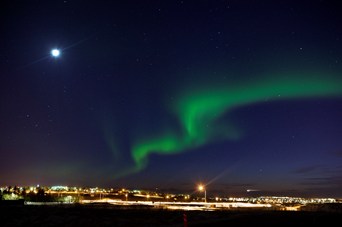
I was unable to capture it on my phone camera, so you can
watch a sped-up video
of the Northern Lights from Finland.


