Showing posts with label Martin Luther King Jr. Show all posts

Wednesday, February 27, 2013

FALLEN HEROES


I guess my mind has been stuck on super-heroes because I have been traveling in other countries on a day that means a lot to me—Martin Luther King Jr. Day, and inauguration day for Obama’s 2nd term. I made a decision a few years ago not to treat specific holidays as a day to relax, go hiking, take a 3-day weekend vacation, or have a picnic. I decided to try to honour the day and those in whose memory it was created. That means doing something for Veteren’s Day and Memorial Day and Martin Luther King Jr. day (Labour Day actually is a day of rest). So while reflecting on the day and the events I was missing, I remembered that part of every rite of passage is the accompanying transition of our super-heroes to a state that is not so super.

I met with my weekly bunch of friends for our latest session on our theme of Superheroes. My friend Richard was leading it, and I know he likes to provoke people so I knew what to expect. Right from the start he created a rich multi-media presentation that called Gandhi a racist pedophile who said we shouldn’t fight Hitler, Dr. King a plagiarizing philanderer, Lance Armstrong a crooked drug king-pen, Mugabe a freedom fighter, etc. He systematically sought to unearth, unhouse, and unsettle any notions of heroes and villains we held.

Luckily, I had already gone through such falls from grace of my heroes (plus I wasn’t sure about all his accusations). Not only did I fall with my heroes in the past, but I came out on the other side. My friend sought to shatter the image of the heroes but he forgot one important thing: we are all a mixture of inconsistent actions and thoughts. The point is to take the good and choose the better history. Yes, Winston Churchill is hailed as a god of freedom while at the same time, denying that very freedom to Gandhi and India. Jefferson crafted the Declaration of Independence and said he would fight tyranny anywhere it reared his heads, yet he called Black people inferior while secretly fathering children with at least one slave. I will still quote the true words of Jefferson regardless of his missteps. I will still imitate the dogged determination of Churchill in the name of freedom even though his understanding of it was narrow. Likewise, I will still push for the truths that I have learned while still working on my own inconsistencies.

You see, the (second) problem with Richard’s attempt to bring low my super-heroes is that he thought we saw them as perfect in the traditional sense. Perfection is not a state, it is a process. You never arrive. Instead to be perfect simply means that you willingly and consciously undergo the process of unlearning and relearning, unlearning and relearning, in cyclical fashion. So I don’t admire someone for being “perfect” or faultless or not making mistakes or not making any big mistakes. Instead I admire how someone handles the mistakes she made. It’s what you do when you know you are wrong. That’s why I’ve told people with a clear conscience, “Imitate me. Be like me.” I’ve never meant that in the actual steps but in my honesty with my steps (or my attempts at honesty). I admire a humble, honest leader who messes up 10 times more than one who never makes mistakes. The reason? Even the one who doesn’t make mistakes, makes mistakes. It’s just that the humble one admits it. And that simple act opens everyone into the public process of unlearning and relearning. That act puts the leader on the same playing field with the followers, in the same boat, and creates a relationally more powerful bond of trust that engenders following more than any “perfect” leader could.

You have to be careful, though. I’ve seen leaders, in an attempt to be humble, “produce” missteps. These leaders will publicly admit these “produced” mistakes with great humility. However, you know they are produced because these leaders always feel the need to share a misstep that is safe, something that is a mistake enough to show they are not perfect, but minor enough to avoid endangering perceptions of the leader. In this way the pseudo-leader can be both humble and safe. A true leader, one who acts as a living sacrifice doesn’t think about self-safety, only authenticity that paradoxically increases the safety of the followers, students, community, congregation, group, or family. And you know these pseudo-leaders are not humble because they proudly use this public display of humility to show how humble they are or even to teach that humility, a characteristic they hold, is important.

RISEN HEROES


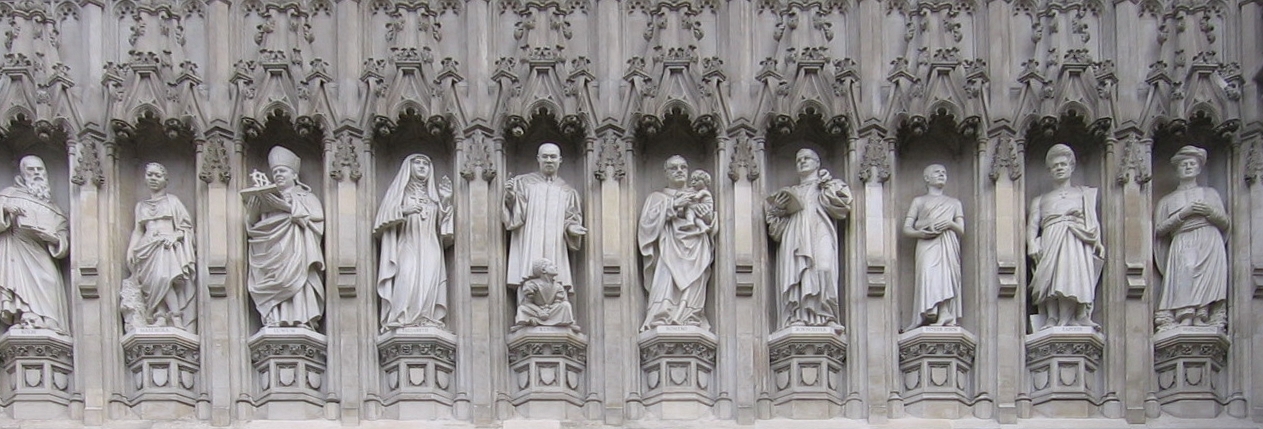
There are some heroes I do like, heroes who, though fallen, have somehow risen in their deaths, an example of the power of the weakness of love (as opposed to Pax Romana, victory through the sword). If you ever visit London, take a trip to Parliament Square and visit the back exit of Westminster Abbey. You’ll see the Westminster Abbey 20th Century Martyr statues. Most of them are great examples of people who were living sacrifices, people whom I believe still would have done much more alive and been a geater blessing alive than physically dead, memorialized, and only alive through their legacy. The difference would have been the legacy. After a natural death after more years of life, they would still be only alive through their legacies, but their legacies would have been much larger.


Saint Maximillian Kolbe (1894-1941) – a Polish Franciscan friar who volunteered to die in place of a stranger at Auschwitz during World War II. It reminds me of a Tale of Two Cities. “A far far greater thing . . .”

Manche Masemola (1913-1928)– a young Pedi (tribe found in South Africa) Christian woman whose parents, thinking her bewitched, beat her to death to force her to consume a traditional remedy used to cure her of her Christianity

Janani Luwum (1922-1977) – an archbishop of the church of Uganda who was murdered by Idi Amin for protesting and being a leading critical voice against the injustice of Idi Amin

Grand Duchess Elisabeth of Russia (1864-1918) – German princess who married a grand duke of Russia and became known for her beauty and work among the poor; she publicly forgave the murderer of her husband and campaigned for his pardon; later she left the crown and became a nun; she was killed by the Bolsheviks (buried alive)

Dr. Martin Luther King, Jr. (1929–1968) – American civil rights leader who advanced nonviolent civil disobedience in the U.S.; he won a Nobel Peace Prize in 1964 and was assassinated due to his efforts

Óscar Romero (1917-1980) – Catholic Bishop in El Salvador and 4th Archbishop of San Salvador who spoke out against poverty, social injustice, assassinations, and torture; he himself was assassinated for speaking out against the injustice and killings; he was a leading proponent of liberation theology

Dr. Dietrich Bonhoeffer (1906 – 1945) – German theologican, anti-Nazi dissident, and founding member of the Confessing Church, he was part of a plan to kill Hitler; the plan failed and he was killed after being caught and imprisoned

Esther John (1929-1960) – a Pakistani Christian nurse and teacher who was brutally murdered allegedly by an Islamist radical

Lucian Tapiedi (1921-1942) – a Papuan Anglican teacher who was a member of a group of workers who were killed by the Japanese during a World War II invasion of New Guinea

Wang Zhiming (1907-1973) – a Christian pastor who was one of many Christian leaders imprisoned and killed during the Chinese Cultural Revolution (1966-1976)

When I think of these heroes I’m reminded of the recent death of Aaron Schwartz. Aaron was an information freedom fighter, but also a general political activist who worked hard to learn the system so that he could practically affect change, always concerning himself with the vulnerable and unheard, always working to close gaps. He developed the RSS feed format that many websites use today, and he did it when he was 14. I always laugh when people talk about how good it feels to help others. Yes, it feels good. But let me tell you, if you really embed yourself in their world and go beyond a superficial veneer of help to really working alongside and relating alongside those in need, it’s not nice. It doesn’t feel good. You often suffer for it yourself. Ask Mother Teresa. Ask Aaron Schwartz. He was known to suffer from depression. And in the end he killed committed suicide.

I am thinking of him because I keep thinking about how the words of friends have memorialized him. If you have a minute, please skim through Dr. Sarah Kendzior’s short Al Jazeera article on one of the battles Aaron fought against – academic paywalls. Then afterwards, please read this Naked Capitalism article on Aaron Schwartz. I didn’t now Aaron, but after reading that, I thought, “If people one day say about me half the wonderful things they said about him, my life would have been a good life.” If instead of people not wanting to be my friend or associating me with different expletives—if people instead talked about me like that, I would be overjoyed, not for my reputation, but for the good chance that it means that I spent my life worthily and left a legacy. He’s a risen hero.

Sunday, February 12, 2012

CONTEMPLATIVE ACTIVIST

I’m quite underwhelmed by myself and my response to the overwhelming issues facing the world, my country, my province/state/territory, my city, my neighbourhood, my community, my house, my family, my self. I’m overwhelmed sometimes just by the enormity of the problems and the energy required to care for victims of our day and age. And when you relate to all kinds of people you are put in touch with all kinds of problems. In these times, you are criticised often by the activists for being too reclusive or resigning to yourself too much. But then you are criticised by the contemplatives for being too activist and reaching out. When reaching out you’re criticised by those who work to address the systemic roots to the problem so that it never happens again. When you join in that work you’re criticised by those who simply care for the victims and manage the problem but don’t work towards eradication.

What I’ve learned is that a true life of contemplation leads to a true life of activism. And a true life of activism fuels a true life of contemplation. Is it not when a person truly contemplates the state of the world, the state of the environment, the poverty & equity crisis (the occupy movement), the annihilation precipice and security crisis, and the prosperity crisis that one is moved to action? They seemed to go hand-in-hand. In fact, this is what we find in the life of Martin Luther King, Jr.


I recently finished “Strength to Love” by MLK which included one essay about his contemplative translation into action. According to MLK, he first read all the theological liberalism he could and he thoroughly enjoyed it. But then he felt it was too overly optimistic about human nature and didn’t see how we could be darkened by wrongdoing or sin. He didn’t enjoy neo-orthodoxy (what was called neo-orthodoxy back then in the 50’s) because it was too pessimistic about human nature, stressing too much a hidden, wholly other, unknown God with a narrow, uncritical Biblicism.

Later, looking for some synthesis of the two, he began to read existential philosophers. He read Kierkegaard, Nietzsche, Jaspers, Heidegger, and Sartre. What amazes me is that some of these men are famous “atheists,” and also read by one of my favorite contemporary activist, story-telling philosophers, Peter Rollins. After MLK did serious study of the 20th-century thinker Paul Tillich, he became convinced that regardless of its fashionableness, existentialism had grasped some important truths about the human condition including the concept of “finite freedom” and the various anxieties and conflicts man must navigate in life and our structure of existence. These anxieties threaten meaninglessness.

After starting in systematic theology and philosophy, MLK was more and more interested in social ethics. After experiencing segregation on the back of the bus or the segregated car on a train behind a curtain, the problem of racial injustice deeply concerned him. He saw it as morally unjustifiable and rationally inexplicable. He saw how the system exploited both blacks and poor whites (there are systems today that still do this).

As he continued to ponder these things, he entered theological seminary beginning a quest to find a method that would eliminate social evil. A huge influence upon him is a book by Walter Rauschenbusch whose great grandson is a colleague of mine. The book is called “Christianity and the Social Crisis.” This book is the book that gave rise to the social gospel movement or the involvement of Christians in a more systemic and organized way in social issues in the States. The anti-child labor movement and the worker rights movement are examples of two movements that came out of it. Through Rauschenbusch, MLK learned or became more convinced of the fact that the gospel deals with the whole man and not just his spiritual well-being. Any religion that professes a concern for a man’s spirit but doesn’t care about the slums that damn him, the economic conditions that cripple him, and the social conditions that harm him is an emasculated religion.

He then went on to study seriously social and ethical theories from philosophy. He saw love (turn-the-other-cheek and love-your-enemy) as a valid philosophy for individual contact but holding no power for group interactions. It wasn’t until MLK read the works of Gandhi that he saw the power of nonviolent love in group interactions. MLK became fascinated with the Gandhian concept of satyagraha [truth/love (satya) graha (force)]. He thought the Christian concept of love working through the Gandhian concept of non-violence could work to bring about change.

But it wasn’t until he was involved in the bus boycott of 1954 in Montgomery, Alabama that he had a situation in which nonviolent resistance could be applicable. Up till then he had only given nonviolent resistance intellectual assent. After being voted the spokesperson of the group and living through the days of the boycott, this idea to which he agreed became a committed way of life for him. Many of the intellectual issues which had not been cleared up for him were cleared up through the sphere of practical action. (At that time he saw love as practical for group relations, but still didn’t realize it could be used for international relations until later.)

Do you see how the contemplation and action wove together in his life? Moreover do you see how the contemplation of those he studied affected him? I often talk about the 4 M’s, but it’s quite important here because without Gandhi there really is no MLK. But without Jesus there is no Gandhi because Gandhi read the words of Jesus and studied his action. Gandhi was another contemplative. And Jesus, whom Gandhi studied, was another contemplative. But from the one called the Messiah to the one called the Mahatma to the one calk MLK, we move to another, a 4th contemplative, Mandela. From South Africa, Mandela studied the example and words of MLK in the States and appropriated such nonviolent resistance and love to help shape a new South Africa birthed from the struggling labour during apartheid.

I don’t know one major leader who doesn’t read, study, contemplate. Even more, the contemplative practice is more than just thinking and reading but truly sitting with a concept and thought, wrestling with what is good for people, and meditating upon these thoughts in silence, stillness, time away from others, time away from the daily grind.

It really isn’t either/or. It’s both.

BEND IT LIKE KING

People talk to me all the time about the misery in the world, and there is a lot of it. There is a lot of mess to clean up, a lot of people who need to hear some good news, a lot of good news that is missing, a lot of war, a lot of poverty, a lot of ecological crises. But people also forget that there seems to be some invisibly guided trajectory of the arc of humanity. It bends towards justice. What has been the determining instigator in every situation? Questions.


The arc of the moral universe is long, but it bends towards justice.

--MLK


Questions help move us along this arc that bends toward justice. Questions allow us to realize that the law (rules and codes) don’t ever achieve the ideal of justice to which they lean. That is why we must always amend them, examine them, unsettle, unearth, and unhouse them—they fall short. And they always will.


There was a time when child labor was acceptable. There was time when the slave trade was not just condoned but encouraged. And even after the slave trade was abolished in many countries, we still had slavery condoned and encouraged (we even have slavery and child labor today). There was a time when women could not vote because they were considered less than men (they still are in many places). There was a time when workers had no rights as to their conditions (thanks Ms. Day). There was a time when the environment was taken for granted (though before there was a deeply embedded understanding of our connection to the environment, that we do not lord it over the environment or rule over it but that we sustain and are sustained by it—that if we deplete or damage the environment we deplete and damage ourselves). Genocide, asbestos, lead in petrol (gas), war crimes, sweat shops, unfair trade policies, etc. The list goes on and on. In all these things, someone asked a question that challenged the conventional wisdom. In all these situations questions led the way for the law to move closer to the justice it idealized.

I must confess, my friends, the road ahead will not always be smooth. There will be still rocky places of frustration and meandering points of bewilderment. There will be inevitable setbacks here and there. There will be those moments when the buoyancy of hope will be transformed into the fatigue of despair. Our dreams will sometimes be shattered and our ethereal hopes blasted. We may again with tear-drenched eyes have to stand before the bier of some courageous civil rights worker whose life will be snuffed out by the dastardly acts of bloodthirsty mobs. Difficult and painful as it is, we must walk on in the days ahead with an audacious faith in the future. ... When our days become dreary with low-hovering clouds of despair, and when our nights become darker than a thousand midnights, let us remember that there is a creative force in this universe, working to pull down the gigantic mountains of evil, a power that is able to make a way out of no way and transform dark yesterdays into bright tomorrows. Let us realize the arc of the moral universe is long but it bends toward justice.

Of course, the quote is beautiful, but it brings up the more profound question. What is justice?