Another funeral that was held recently was for Mariam Makeba. She is a Grammy-award winning artist who has also won a few peace prizes as well (not Nobel). She died of a heart-attack, I believe, in Italy after a performance. You may have seen her guest start on the Cosby Show back in 1991 after returning to the country from exile in 1990 (Mandela asked her to come back). She was also in Sarafina (with Whoopie; she played the mother of Sarafina).
I think I first heard of her from watching “An Evening with Belafonte/Makeba” a live album recorded and video recorded back in 1966 for which she won a Grammy. You might know “Malaika” or “Pata Pata.” I first heard “In the Jungle” from her but in a style I’ve never heard in the States. Perhaps it’s the original African style, not the one that became popular in the States.
Because that album dealt with apartheid and speaking out against it, her passport was revoked in 1960 when she tried to go back to attend her mother’s funeral. In 1963 after testifying against apartheid to the UN, her citizenship and right to return were revoked by South Africa. Wow. She was offered honorary citizenships by 10 countries and has had passports from 9 countries. She’s the biggest internationally-known South African music star. And you can read more about her on Wikipedia.
http://en.wikipedia.org/wiki/Miriam_Makeba
The Christmas lights are up in downtown Cape Town. They’re quite pleasant and they are different from last year. I like that they change them and keep them new. For pictures go to one of my facebook picture pages.
Love in the Time of Cholera
I just saw this movie on DVD at a friend’s house. My goodness! They chose that actor Javier (don’t know his last name) who also did Goya’s Ghosts. He has a way of playing very pitiful characters that makes you hate the person or over sympathize. It can be hard to watch. The character himself was quite pitiful trying to feel the void of love with lust.
Slum Dog Millionaire
Go see this one! I enjoyed it. I had heard of it and didn’t realize I had. In South Africa we get movies 3 months or so (sometimes sooner) later than the U.S. release. So it hasn’t here in South Africa yet. But someone took me out to a movie when I arrived in the States. It’s not Bollywood if you dislike that (I think those movies are fun). But they do a funny B0llywood spoof during the credits (I think it’s a parody; I’m not sure). The story is about a boy who gets all the questions right on “Who Wants to be a Millionaire?” And before they can go to the final question the next day on the show, he’s questioned by the police for cheating. The movie shows how he knew the answer to each question which was (some would say) by pure random chance of events in his life. This is one of those movies that reinforce what people have always told me about those game shows. Sometimes it just so happens that the questions line up with your experience and it works—luck. Sometimes it’s completely out of your studying knowledge and experiential knowledge and you lose.
Patience,
Victor
Wednesday, January 28, 2009

Saturday, November 22, 2008
UPDATE - November 21, 2008
November 21, 2008
“Nothing in all the world is more dangerous than sincere ignorance and conscientious stupidity.” -MLK
My friend made a commercial about Doritos I believe. I haven't watched it, but enjoy.
http://www.crashthesuperbowl.com/#/gallery/video/1201/
http://flickr.com/photos/barackobamadotcom/sets/72157608716313371/show/
Notice to All Employees
As of November 5, 2008, when President Obama is officially elected into office, our company will instill a few new policies which are in keeping with his new, inspiring issues of change and fairness:
1.All salespeople will be pooling their sales commissions into a common pool that will be divided equally between all of you. This will serve to give those of you who are underachieving a "fair shake."
2.All hourly employees will be pooling their wages, including overtime, into a common pool, dividing it equally amongst yourselves. This will help those who are "too busy for overtime" to reap the rewards from those who have more spare time and can work extra hours.
3.All top management will now be referred to as "the government." We will not participate in this "pooling" experience because the law doesn't apply to us.
4.The "government" will give eloquent speeches to all employees every week, encouraging its workers to continue to work hard "for the good of all."
5.The employees will be thrilled with these new policies because it's "good to spread the wealth." Those of you who have underachieved will finally get an opportunity; those of you who have worked hard and had success will feel more "patriotic."
6. The last few people who were hired should clean out their desks. Don't feel bad though, because President Obama will give you free health care, free handouts, free oil for heating your home, free food stamps, and he'll let you stay in your home for as long as you want even if you can't pay your mortgage. If you appeal directly to our democratic congress, you might even get a free flat screen TV and a coupon for free haircuts (shouldn't all Americans be entitled to nice looking hair?) !!!
If for any reason you are not happy with the new policies, you may want to rethink your vote on November 4th.

Why did the chicken cross the road?
BARACK OBAMA: The chicken crossed the road because it was time for change ! The chicken wanted change !
JOHN MC CAIN: My friends, that chicken crossed the road because he recognized the need to engage in cooperation and dialogue with all the chickens on the other side of the road.
SARAH PALIN: That road the liberal media claim that chicken crossed? Well, that is the Road to Nowhere, and I told Congress. Thanks, but no thanks to that. So, there isn't any road for that chicken to cross and any reporter who says otherwise ought to be fired.
HILLARY CLINTON: When I was First Lady, I personally helped that little chicken to cross the road. This experience makes me uniquely qualified to ensure right from Day One! that every chicken in this country gets the chance it deserves to cross the road.. But, then, this really isn't about me.
GEORGE W. BUSH: We don't really care why the chicken crossed the road. We just want to know if the chicken is on our side of the road, or not. The chicken is either against us, or for us. There is no middle ground here.
DICK CHENEY: Where's my gun?
COLIN POWELL: Now, to the left of the screen, you can clearly see the satellite image of the chicken crossing the road.

BILL CLINTON: I did not cross the road with that chicken. What is your definition of chicken? What is your definition of cross?
AL GORE: I invented the chicken.
JOHN KERRY: Although I voted to let the chicken cross the road, I am now against it! It was the wrong road to cross, and I was misled about the chicken's intentions. I am not for it now, and I will remain against it.
AL SHARPTON: Why are all the chickens white? We need some black chickens. This is America.
DR. PHIL: The problem we have here is that this chicken won't realize that he must first deal with the problem on this side of the road before it goes after the problem on the other side of the road. What we need to do is help him realize ho w stupid he's acting by not taking on his current problems before adding new problems.
OPRAH: Well, I understand that the chicken is having problems, which is why he wants to cross this road so bad. So, instead of having the chicken learn from his mistakes and take falls, which is a part of life, I'm going to give this chicken a car so that he can just drive across the road and not live his life like the rest of the chickens.
ANDERSON COOPER, CNN: We have reason to believe there is a chicken, but we have not yet been allowed to have access to the other side of the road.
NANCY GRACE: That chicken crossed the road because he's guilty ! You can see it in his eyes and the way he walks.

PAT BUCHANAN: To steal the job of a decent, hardworking American.
MARTHA STEWART: No one called me to warn me which way that chicken was going. I had a standing order at the Farmer's Market to sell my eggs when the price dropped to a certain level. No little bird told me any insider information.
DR SEUSS: Did the chicken cross the road? Did he cross it with a toad? Yes, the chicken crossed the road. But why he crossed I've not been told.
ERNEST HEMINGWAY: To die. In the rain. Alone.
JERRY FALWELL: Because the chicken was gay! Can't you people see the plain truth? That's why they call it the 'other side.' Yes, my friends, that chicken is gay. And, if you eat that chicken, you will become gay, too. I say we boycott all chickens until we sort out this abomination that the liberal media whitewashes with seemingly harmless phrases like 'the other side.' That chicken should not be crossing the road. It's as plain and as simple as that!
GRANDPA: In my day, we didn't ask why the chicken crossed the road. Somebody told us the chicken crossed the road and that was good enough.
BARBARA WALTERS: Isn't that interesting? In a few moments, we will be listening to the chicken tell, for the first time, the heart-warming story of how it experienced a serious case of moulting - and went on to accomplish its lifelong dream of crossing the road.
ARISTOTLE: It was in the nature of the chicken to cross the road.
JOHN LENNON: Imagine all the chickens in the world, crossing all the roads together, in peace.
BILL GATES: I have just released eChicken2008 which will not only cross roads, but will lay eggs, file your important documents and balance your checkbook with a single keystroke. Internet Explorer is an integral part of eChicken2008. This new platform is much more stable and will never require a reboot.

ALBERT EINSTEIN: Did the chicken really cross the road, or did the road move beneath the chicken?
UPDATE
Things are ok here. Two weeks ago I submitted two drafts (the 2nd draft on one and the 3rd draft on another) of provisionally accepted papers. We'll see if they take it. They are allowed to say no in the end. I was shocked that they would ask for a 3rd version, but we will see. I also yesterday (the 20th of November) submitted a 1st draft of a new paper to an African Journal in mathematics and computer science research. So that's 3 papers out. I have one more to submit by the end of next week I hope. And then I'm “all papered out.” I'll need to finish new research for any more work. I'm still stuck on the artery project, but I'm hoping it will become clear.
Things are quiet on campus as exams have finished and many students have gone home. Graduation is coming in December and it usually takes 5 days because UCT (a university of 20,000) has no adequate venues for large groups. I think there are usually 2 ceremonies a day for the week.
Oh, one interesting thing that happened last week. People who help lead (they don't say “teach” because at my church we tend to facilitate small group discussion, lead songs, perform dramas/puppetries, do interactive programs with the kids, give 10-minute “talks”, etc.) my Sunday school group (grades 1-3) asked me for behavior/discipline help because they had heard I had worked with the roughest toughest kids in the worst urban schools. I laughed when I heard this. I was also asked to write something on play therapy to help small group discussions with the grade 1 boys. Well, needless to say some ages are not cut out for small group discussions even if it is after a 10-minute talk that drives home the lesson. But I helped by giving some child therapy techniques used in therapy. But my fellow-leaders would use them to help the little kids answer discussion questions (not to help with emotional and behavioral problems). I asked some YES teachers for some help with the discipline topic, but I never heard anything, so I just wrote something myself and e-mailed them all. Now I've been asked to actually do play therapy counseling with one troubled boy once a week. “It's just an idea,” the church children's administrator told me. So we'll see. It is rather exciting. Most Mondays I go I receive no counseling patients (I think it's hard for people to go to a church for HIV/AIDS or crisis pregnancy counseling especially if they attend that specific church, even if we do advertise outside), so this would be welcome. I need to make sure the child is safe though. We'll see what the counseling supervisors say since I'm not a multi-year trained child psychologists/child therapist.
Things below to look out for:
Final sermon in the Sex and the City Series
Economics II – the world financial crisis final explanation
U.S. Elections and Obama
Poverty and the U.S. Tax system
SEX and the CITY FINALE

http://www.jubilee.org.za/
Well, the series is finally over. We had the second talk on homosexuality. And after talking to my friend struggling with homosexuality I found out that he felt very bad, very, very bad after the first talk on homosexuality. I missed the talk but it surprised me because two people told me the pastor spoke well, and that it was soo good that the pastor mentioned both grace and truth though he is more of a truth guy. My friend Michelle (lawyer extrodinaire from Penn State doing the 2nd semester [U.S. fall semester] abroad here at UCT) said he also did well by simply telling what God thinks about it and not saying what he thinks or not saying what is. The pastor simply said what the Bible says and what God thinks. Perhaps this is what made my friend feel bad. I'm not sure. I will meet with him later this weekend.
But thankfully this last talk made my friend feel better. This talk was about hope or acceptance or love. Actually hope is the best word. . . hope for change. The pastor said your identity is not as a homosexual, but it is as a Christian. I agreed with him that homosexuality was not anyone's identity as a Christian because as a Christian the thing you most identity with is supposed to be Christ.
For example, in the U.S. I sometimes battle with Black Christians who have a deeper sense of identity in their Blackness than in their walk with God. The reason I say this is when something naturally conflicts between the two (as conflicts naturally arise in many areas of life), I side with my relationship with Christ since it most defines me; this happens naturally. It is my first sense of identity, my deepest definition. I remember I once told one of my most beautiful friends (Jenny Darrah, she's a sociologist and has forgiven me for the comment) that there was a limit to how deep our friendship could be because of the difference in our views. Since my deepest connection was with Christ it was difficult to share that deepest part of me or for others to understand that part of me if that same connection was not there. I don't remember what sparked the comment but it was not meant rudely or badly; it was just an observation due to some perceived trouble to communicate something (I really don't remember what sparked it).
So when the pastor said his comment, I understood it like that. But, he may have meant that gay people were not gay. That was something different. This then took us into the question of can you be born gay. He seemed to be saying it wasn't their identity. Even though I identify first with being a Christian, it doesn't mean I'm not black. I still am black. I was just articulating my deepest sense of identity. And what the pastor said worked for people who were just bi-curious, people who chose to be homosexual, people who consciously or subconsciously turned against the entire opposite gender due to an incident in their life or a lack of love or the hardness of a father. But the question remained: what about people who have homosexual tendencies and never had any bad event happen, nothing noticeable? What about the people who grew up in strong, wonderful, loving, heterosexual homes? Is it part of the their identity or no?
His argument was that it is not part of anyone's identity. And we saw a moving video about a guy who struggled with homosexuality for years but was eventually saved from it and redeemed, and found a woman, married her, and is having their 1st baby after dealing with sterility for awhile. It was quite an amazing and moving story.

During the Q&A, the question of whether a person can be born gay came up. The pastor brought up the fact that people can born all sorts of ways; that doesn't mean you deal with it and you accept it. If someone is born with a deformed hand, you try to medically fix it. I know this type of analogy is offensive to some people but he seemed to be admitting you can naturally be born that way through no noticeable life-altering event or decision in your life. This is important to my friend who doesn't know of any decision or point at which he chose this or turned away from women.
Someone then asked if homosexuality can be genetic. The pastor said there is no medical proof concluding it's genetic (some people don't like this because how can you find medical proof that it is genetic?), but he quoted 4 problems with possibility of it being genetic. They come from Piper whom my pastor reads and quotes a lot:
1)If it were genetic, homosexuality would seem to kill itself off because by passing on homosexuality to your children you decrease the number of people able to reproduce (which requires heterosexual copulation). Homosexuality works against itself in an microevolutionary way.
2)If it were genetic, then the proportion of homosexual people would remain constant over time. When you study history, there are times (and places) of higher rates of homosexuality and lower rates, explosive times and minimal times.
3)If it were genetic, then two identical twins with the same exact DNA should both be homosexual or both be heterosexual. Instead, as it is, when one twin is homosexual, there is only a 50% chance the other identical twin is homosexual.
4)If it were genetic, it could never be cured/removed. A person could never be delivered from it. Yet this has happened.
Though they were a good attempt, I found fault with 3 out of 4 of them. Most of them fail because they assume that it is ONLY genetic. I already know many people who have chosen it or became homosexual after a bad or tough incident in their life. Given the fact that both can be happening at the same time (people born with it and others developing it), most of the reasons above fall away. Remembering that homosexual people also marry heterosexually and have kids (some try to have a heterosexual lifestyle), number one falls away.
Number two falls away for the same reason. The roots of number 2 do not have to be genetic but can be social or sociocultural as well. If one studies Biblical history you know homosexuality was around very early from the beginning which means Number two is not about the genetics of homosexuality but can be due to what is accepted in a society who is leading the society/country and the established rules. Moreover, evolutionarily, genetic characteristics and adaptations can flourish and die at different times. That is possible.
Number 4 was a bit appalling to me because the Christian proponent of that argument is someone who is supposed to believe in the power of God to do anything. Either he can do the impossible or he cannot regardless if something is volitional, genetic, or environmental. So though that makes sense in an areligious context, but it falls apart within the belief system of some sects of Christianity (definitely the one of the proponent of the argument).
In actuality you can argue anything away, even if it does make sense or is true. The same is true here. Outside of such arguing, the only legitimate one that seems to make sense is #3.
So the Q&A was very interesting to me, perhaps more interesting than the actual sermon. That's why I made sure to attend the evening service with the text messaging and questions. There was one other comment in the Q&A that surprised me greatly. Someone asked the following.
You have said that Christian leaders who have said unBiblical statements marring the truth about homosexuality should apologize for what they have said. [Since you said last week that we need both grace and truth] do you also think Christian leaders who have not shown any grace should apologize?
It was an excellent question and showed a bit of the bias in the sermons toward the side of truth. He is a big truth guy. But he gave the correct answer. Yes. They should also apologize, he said. The surprising part was his following elaboration. “In my experience, homosexuals are usually loved by me and fellow Christians. People struggling with homosexuality have always been welcomed here in this church and I have not seen people hating them. So I think this church is very accepting and loving. I would say the same thing of other churches. I really have not seen Christians being unloving towards homosexuals or yelling and screaming at them. In my experience I have seen the opposite: Christians marring the truth of scripture on homosexuality. That is the great danger. From what I have seen and experienced that is the huge problem and needs correction. I have seen many leaders get up and say untruthful (unBiblical) things about whether homosexuality [homosexual intercourse] is ok. In my experience I have not seen a lack of grace towards homosexuality. I don't know. Maybe people have seen others lack grace. But I'm just speaking from my experience. In my experience it is the lack of truth that is the huge problem in Christianity today.”
That part just took me back a bit. I tried to think how that was the case. Maybe it's because he's a pastor and he just reads books by pastors he likes and statements by pastors/leaders he disagrees with and his focus is on church leaders. Maybe he doesn't get out much. Maybe he doesn't have homosexual friends. I'm not sure. But I have never heard ANYONE say that. Maybe my group of Christian leaders is not diverse enough. But everyone I have seen and spoken with will say that the largest problem is the lack of grace shown to homosexuals (or they may not realize this as they are not showing grace). I'm pretty sure that's true. We, as Christians (some of whom are homosexual) have not done a good job of simply being like Jesus and loving them like we love ourselves, like we're supposed to love our neighbor, like we're supposed to love our enemy, like we're supposed to love God. They have felt ostracized, marginalized, loathed, hated, discarded, etc. It's for that very reason that you have homosexual churches because many don't feel comfortable or welcome in churches today. So I was just surprised by his comment. Perhaps it's different in South Africa. He's probably viewing it from a church leader's standpoint looking at other church leaders. But I would say the biggest problem is grace.
If you have time or ever read excerpts from books at the book shop, go look for a book in the religion/religious studies/Christian (inspirational living/daily living) section entitled “What's So Amazing About Grace?” by Philip Yancey. He's an editor of a Christian magazine and a layperson (not clergy). He writes wonderful inquisitive, insightful, thoughtful books and reveals his own prejudices sometimes. In this book he has a chapter about a gay Christian friend of his. It's in Part III of the book. I believe it's Session 6: Grace Put to the Test: Grace in the Face of Disagreement.
Here's an excerpt from the beginning of the book.

Chapter One
The Last Best Word
I told a story in my book The Jesus I Never Knew, a true story that long afterward continued to haunt me. I heard it from a friend who works with the down-and-out in Chicago:
A prostitute came to me in wretched straits, homeless, sick, unable to buy food for her two-year-old daughter. Through sobs and tears, she told me she had been renting out her daughter — two years old! — to men interested in kinky sex. She made more renting out her daughter for an hour than she could earn on her own in a night. She had to do it, she said, to support her own drug habit. I could hardly bear hearing her sordid story. For one thing, it made me legally liable — I’m required to report cases of child abuse. I had no idea what to say to this woman.
At last I asked if she had ever thought of going to a church for help. I will never forget the look of pure, naive shock that crossed her face. “Church!” she cried. “Why would I ever go there? I was already feeling terrible about myself. They’d just make me feel worse.”
What struck me about my friend’s story is that women much like this prostitute fled toward Jesus, not away from him. The worse a person felt about herself, the more likely she saw Jesus as a refuge. Has the church lost that gift? Evidently the down-and-out, who flocked to Jesus when he lived on earth, no longer feel welcome among his followers. What has happened?
The more I pondered this question, the more I felt drawn to one word as the key. All that follows uncoils from that one word.
This is an interview of him by a magazine.
http://www.whosoever.org/v8i6/yancey.shtml
DINNER ECONOMICS & POVERTY in AMERICA
Forwarded E-mail
This is beautiful, this guy need to get a medal for this
Suppose that every day, ten men go out for dinner and the bill for all ten comes to $100.
If they paid their bill the way we pay our taxes, it would go something like this:
The first four men (the poorest) would pay nothing.
The fifth would pay $1.
The sixth would pay $3.
The seventh would pay $7.
The eighth would pay $12.
The ninth would pay $18.
The tenth man (the richest) would pay $59.
So, that's what they decided to do. The ten men eat in the restaurant every day and seemed quite happy with the arrangement, until one day, the owner threw them a curve.
“Since you are all such good customers, he said, I'm going to reduce the cost of your daily dinner by $20.”
Drinks for the ten now cost just $80. The group still wanted to pay their bill the way we pay our taxes so the first four men were unaffected. They would still eat for free. But, what about the other six men the paying customers? How could they divide the 20 windfall so that everyone would get his 'fair share?'
They realized that $20 divided by six is $3.33. But if they subtracted that from everybody's share, then the fifth man and the sixth man would each end up being paid to eat his dinner. So, the restaurant owner suggested be fair to reduce each man's bill by roughly the same amount, and he proceeded to work out the amounts each should pay.
And so:
The fifth man, like the first four, now paid nothing (100% savings).
The sixth now paid $2 instead of $3 (33%savings).
The seventh now pay $5 instead of $7 (28%savings).
The eighth now paid $9 instead of $12 (25% savings).
The ninth now paid $14 instead of $18 (22% savings).
The tenth now paid $49 instead of $59 (16% savings).
Each of the six was better off than before, and the first four continued to eat for free. But once outside the restaurant, the men began to compare their savings.
'I only got a dollar out of the $20,'declared the sixth man. He pointed to the tenth man, 'but he got $10!'
'Yeah, that's right,' exclaimed the fifth man. ‘I only saved a dollar, too. It's unfair that he got ten times more than I!'
'That's true!!' shouted the seventh man. 'Why should he get $10 back when I got only two? The wealthy get all the breaks!'*
'Wait a minute,' yelled the first four men in unison. 'We didn't get anything at all. The system exploits the poor!'
The nine men surrounded the tenth and beat him up.
The next night the tenth man didn't show up for drinks, so the nine sat down and had dinner without him. But when it came time to pay the bill, they discovered something important. They didn't have enough money between all of them for even half of the bill! (The 10th man was originally paying $59 of $100, then $49 of $80)
And that, boys and girls, journalists and college professors, is how our tax system works. The people who pay the highest taxes get the most benefit from a tax reduction. Tax them too much, attack them for being wealthy, and they just may not show up anymore. In fact, they might start drinking overseas where the atmosphere is somewhat friendlier.
David R. Kamerschen, Ph.D.
Professor of Economics, University of Georgia
For those who understand, no explanation is needed.
For those who do not understand, no explanation is possible.
Ok, so along with the first forward of the company policy in honor of Obama being elected, I received the above as well. The above one on our tax law is really the only constructive thing to which I should reply. I didn't bother pasting a third e-mail which was quite personal and I thought inappropriate. This e-mail on tax actually looks at the actual tax policy and doesn't make personal attacks like we saw in the campaign. So, let's take a look at it.
IF this is really from a Professor of Economics at University of Georgia, I first must applaud her because she gives us something we can study and analyze and look at. It's not just complaint but an alternative (well it's the status quo but an alternative to what Obama or a stereotypical Democrat would do). So thanks for that. Let's clear up a few things.
1.I think the wording of the e-mail can be confusing to people. Notice the colored words like eat and dinner. It might give the fallacy to some that the metaphor of dinner or eating corresponds to eating food and spending the money you receive in life. To clarify, that is not what it refers. Eating dinner in the above dinner economics refers to receiving the benefits of citizenship or any services, products, security, or structure the government provides. So having a U.S. Postal Service where you can pay money for someone to mail something is like eating dinner. Having volunteers run voting polls where you can vote is like eating dinner. Government programs, social security, and the military are like eating dinner. I hope that helps. Eating dinner is NOT getting money without having a job and working. This is very important to understand because the e-mail may make you think that the poorest people who “pay” nothing for the “meal” have no jobs. That's not necessarily true. The meal is not income; the meal is government provision—everything the government does.
2.The second point to realize is that it is just analogy. Analogies tend not to be perfect. So make sure you don't think that the poorest people are jobless. That is not necessarily true. You can be in the poorest category and below the poverty line and have a full-time wage-earning job. So please don't association personality characteristics, drive, or lack of motivation with the poorest people. Eating for free does NOT mean you are not working. It represents receiving benefits of being a citizen without paying taxes.
3.The third point to remember is that though the analogy is simple, in reality all 10 people do not eat the same meal at the same restaurant receiving the same care. Not all 10 men would have access to the same FOOD (if the analogy were perfect). Just one example would be public schools (a type of food). If you are the poorest and you live the poorest neighborhoods, there is a high probability you go to the worst or one of the worst schools in terms of performance, supplies, teaching, etc. You have less of an ability to learn, do well, and pull yourself out of the position and system you feel locked. The 10th guy has children who go to an amazing school that all teachers would like to teach at. There are more than enough supplies and the children have less distractions to performing well. Of course I'm polarizing it. You can do well in a poor school and poorly in a rich school. But go and look up the correlation between income-level of parents and children's school performance. I'm not making it up. So just remember the food is not the same. The service is also different.
4.The numbers used by the professor look good. A different perspective is to show the percentage the tax payment (dinner price) comprises of the income of the person. You could also look at the percentage the tax saving comprises of the income of the person. That shows a different spin.
5.I'm not sure about the last part where the 10th man didn't show up. I'm assuming that's doesn't actually correspond to anything happening in today's society, just an apocryphal prediction. I don't think rich people leave the US in any appreciable numbers due to being taxed too much. I could be wrong, but I'm not worried about that.
What's the point? The people paying the most for dinner get better food and service and access to the managers. But even if we assume the food is the same and the service is equal, there is still a point. The point is that it actually DOES make sense for the people who pay the most in taxes to receive the largest benefit from tax reduction. It makes completely sense. I expect rich people to think so. It follows according to what is fair and according to self-interests. It's the natural way to think. It makes sense.
I'm just looking for a higher way.

In “Mountains Beyond Mountains” Paul Farmer (medical anthropologist and medical doctor who has done amazing work in Haiti, Peru, Rwanda, Russia, etc. in raising life expectancy rates, lowering infant mortality rates and diagnosing and treating MDR and XDR TB) was amazed that his friend who financed a lot of his work would vote against his interests. This rich friend was willing to vote for someone who would not reduce tax burdens on the rich or on corporations. This was not in his direct interests. But this rich man saw something higher or better.

There's a others-focused way that we are talking about. For a rich person, receiving more tax reduction seems fair. But we are searching for what is just. There is a difference. And justice is the higher ground.
In the last update, I wrote about liberation theology and the preferential option for the poor. I wrote about siding with the rich, even if completely sincere or unaware, was unjust, and the cause of the poor (no matter their motivation or characteristics) is always just. Why? According to the Judeo-Christian tradition, that's how God's mind works (even in Buddhism [especially the Tibetan form] and Islam the poor are very important to God).
Thomas Jefferson had a Bible in which he cut out all the passages that he didn't agree with. I think it is called the Jeffersonian Bible. It had a lot of holes. Many pastors quote this story as an example of someone who selectively follows God. Yet, simultaneously without physically cutting out passages, many people selectively follow parts of the Torah or Bible.
Jim Wallis (author of a number of books including God's Politics, editor of Sojourner's magazine) had a group of friends in seminary that met together. They were a group of “activist evangelical seminarians” who began to look at the Bible on their own (they went to a conservative seminary—Trinity in Chicago). They did a study to find every verse in the Bible on the poor. They found several thousand verses on poverty, treatment of the poor, and God's reaction to the injustice. It was the second most prominent them in the Hebrew Scriptures (old testament) behind idolatry. And the two (money/poverty and idolatry) were often related. In Matthew, Mark, and Luke poverty appears in one out of very ten verses. In Luke alone it is one in seven.

They took out a pair of scissors and began to cut every single verse on the poor. It took a long time, says Jim. They had to cut through any prophet who spoke out against nations for neglecting the poor and the rich who ignore the poor (sound familiar). They cut through Amos, Isaiah, Micah, much of the Psalms, Leviticus, etc. In the New Testament there was more work with Jesus quoting Isaiah when he said he was sent to bring good news to the poor, Mary's Magnificat, the Beattitudes, the Sermon on the Mount, the early church in Acts, James and his social gospel (faith without works is dead), etc. On and on.
When they were done the Bible could barely stand together because it was so full of holes. From then on Jim would take the Bible to speak (it was very damaged and fragile) and show people that the American Bible was full of holes. It's a good reminder to take our religious texts and cut out holes of verses we pay no attention to. It started Jim on a movement that lasted his whole life long.
I'm using his book as I write this and I want to share three stories from the summer of 2003 that he points out in a chapter called “Isaiah's Platform” in the section called Part IV Spiritual Values and Economic Justice, When Did Jesus Become Pro-Rich? (the other main sections are when did Jesus become pro-war and when did Jesus become a selective moralist)
Story 1:
Susan Hamill, a University of Alabama tax law professor (someone who could understand the above e-mail forward and answer it) decided to go get a masters in theological studies during a year sabbatical. Her thesis was entitled “An Argument for Tax Reform Based on Judeo-Christian Ethics.” She applied Judeo-Christian ethics to Alabama's tax system which she saw as imperative toward ensuring that Alabama's kids (especially from low-income families) had an opportunity for a positive future.
Alabama has long had one of the worst (regressive) tax systems in the country, according to Jim Wallis. A family of four earning $4600 a year has to pay income taxes, the lowest threshold in the entire U.S. (the 50 states). Property taxes are the lowest in the nation (71% of the land is timber so the timber industry is happy); sales tax is 4%, but cities can add to it. Some counties (after adding to it) it is as high as 11% and even on groceries. Watch this: People with incomes below $13,000 pay 10.9% of their income in taxes while those who make more than $229,000 pay only 4%. This was point number 4 in the above. The rich who complain about wanting a larger reduction in their taxes because they pay more, feel the reduction much less. They even feel the payment of taxes less. The poor feel it heavily. Percentage of income is another way to look at it. And if you want to talk about fairness, is that fair?
Long story short, her thesis was published in the Alabama Law Review. The governor Bob Riley (a conservative Republican) saw it and read it at a time there was a budget deficit ($700 million) in Alabama. But states are required to balance their budget (unlike the federal government). So he made a plea to State Congress: We can't balance the budget with cuts alone unless we want to lay of teachers, cancel extra-curricular activities, open prison doors, kick people out of nursing homes, etc. He gave a plan, a tax-reform package to raise property taxes, higher income taxes on the wealthy, and no income taxes on the poorest people. He proposed to raise the threshold to $17,000 paying for it by tax from the timber industry.
Though the churches were behind it, it failed (large anti-proposal campaign by big business and special interests). When asked why he had a change of heart and proposed this plan the governor said “According to our Christian ethic, we're supposed to love God, love each other, and help take care of our poor. And this is a step in the right direction.”
Story 2:
This story shows what happens many times with the poor and poor children in the halls of the legislature. This is just one example, but a big one.
There was a $350 billion tax cut passed by Congress (do you remember this? I do). It primarily benefited the wealthy (I didn't realize this at the time). Each millionaire would receive $93,000. But not even 1% ($3.5 billion) could be used for poor families. Part of the money was for middle and upper income families. Each family would get a check for $400. An amendment was added to make sure it was refundable so that working families earning between $10,500 and $26,625 would also get money.
Then the New York Times revealed that House and Senate Republicans removed the child tax credit from families who make under $26,625 in a late night revision of the bill that Bush signed into law. It prevented 12 million kids from getting any benefit (1 in every 6 kids in the U.S.). Middle and upper-middle income families would get an increase from $600 to $1,000 but nothing for low-income families. They were originally in the package, but they were removed to make room for more dividends and capital gains tax cuts for wealthy Americans (this happened in a late night conference). When this was revealed only two senators both women, one a Democrat and the other a Republican, Arkansas' Blanche Lincoln and Maine's Olympia Snowe demanded that it be corrected. The Senate voted to fix the omission” in a 94-2 vote. Republican leadership in the house used the correction to tack the low-income family child tax credit onto another tax cut for wealthier families! Then the issue deadlocked. Some Republicans admitted their tactic was an attempt to kill the low-income family child tax restoration. So when checks went out, none went to low-income working parents. Tom DeLay said that “There are a lot of other things that are more important than that.”
Story 3:
For it's annual 2000 tax analysis, the IRS found that the top 400 taxpayers (only 0.00014% of the population) take in more than 1% of the total income of all taxpayers (assuming equal distribution you might expect 1% of the population to take in 1% of the income of all taxpayers or 0.00014% of the population to take in 0.00015% of the income of all taxpayers). A the same time their tax payments were dropped significantly lower due to reductions in capital gains taxes. From 1992 to 2000 the average income of the top 400 increased to $174 million while the average income of the bottom 90% was $27,000. The inequality becomes a moral issue for many. The income gap has become a “vast chasm” according to the Wall Street Journal, “so much money in so few hands. . .a startling accumulation of wealth at the very top of the income pyramid.”
So that's that. Whenever you bring these issues up, wealthy Americans or people who label themselves conservatives accuse you of engaging in class warfare. But you have to understand, as Wallis says, there was warfare already going on: “warfare of tax cuts and budget priorities that make the rich richer while further decimating low- and middle-income families.” We shouldn't stand for it.
Budgets are moral documents. Tax cuts for the rich and the Iraq war have killed hopes for America's poorest children. Here are some of them below.
http://edition.cnn.com/2008/US/11/18/hungry.kids.ap/index.html
I could go on for pages, but you get the point. I could talk about corporate greed and Enron, WorldCom, and the current financial crisis related to the poor. I could talk about it globally and talk about debt forgiveness and justice for the world's poor by the rich countries (especially the WTO, World Bank, IMF, fair trade and rich country subsidies that hurt the world's poor). But you get it and this update is long already.
I actually don't mean to mention Bush a lot. Wallis doesn't pull any punches and he'll talk about Republicans for favoring the rich and using religious rhetoric or God to do or Democrats for not even using God at all and favoring the middle class over the low-income or immediate needs for the needy verses long-term solutions and the root causes.
A lot of the faith-based initiatives (any faith) felt their work was futile because programs that reduce poverty (domestic tax and spending policies) were ignored or neglected because of the war in Iraq. So these faith based communities who often bear the weight of taking care of the poor and needy felt they were acting in a hollow manner without the government partnering with them in this work. So they called a meeting with White House with the top domestic policy officials in the Bush administration. US Conference of Catholic Bishops, faith-based social services, advocacy organizations, Salvation Army, World Vision, Bread for the World, Evangelicals for Social Action, heads of mainline and evangelical Protestant denominations—everyone was there.
At one point in the meeting, a leader confronted the officials and said, “I voted for President Bush, I supported you all because I liked the language of 'compassionate conservatism.' But I am just a hair's breadth away from concluding the whole thing was a trick, just to focus our attention away from poverty policy and put the whole burden of reducing poverty back on the shoulders of the faith community.” Jim Wallis writes that you could hear a pin drop in the room. The officials were quiet and agreed to meet again with the leaders and talk about this more.
Space doesn't permit me to write more, but it very possible to be a married couple in the U.S. and have both spouses working and still not make enough money for transportation, food, housing, etc., for basic needs. This has been shown. So go research this or find a contrary research article saying the opposite, but educate yourself and do something about it.
Finally from Wallis's book he concludes this section in this chapter in the Part of the book with an excerpt from E.J. Dionne's comment on the religious leaders letters sent to the White house.
“. . .it's precisely because I don't want the faith-based approach to be a cover for the wholesale abandonment of government's responsibilities that I share the dismay of the religious leaders who wrote to Bush. Millions of working people are poor—and lack health insurance and adequate child care—even though they do all the things that society and our religious traditions say they should. Religious groups will never have the money to transform the material conditions of these families. But relatively modest government outlays could make their lives much better.
There is a religious mandate for such an approach. “Jewish prophets and Catholic teaching both speak of God's special concern for the poor. This is perhaps the most radical teaching of the faith, that the value of life is not contingent on wealth or strength or skill, that value is a reflection of God's image.”
Those thoughtful words are George W. Bush's. Is it too much to ask him to explain how his policies live up to that vision?
Washington Post June 10, 2003
Lastly, as I said, not all wealthy people support more privileges for the wealthy as Wallis would put it. Look at Bill Gates, Sr. President Teddy Roosevelt proposed an estate tax to counter wealth aristocracies. It's meant to moderate the enormous passing on of wealth from one generation to another and is levied on the top 2 percent of American people. The Bush administration (at the time) was trying to phase out the estate tax starting in 2001 with a complete repeal in 2010 and a restoration in 2011 (as an attempt to sell the package). The government would lose $982 billion in 20 years if that had happened. So Bill Gates Jr favored the tax cut and was at a rally on the Capital grounds with Jim Wallis. In a Sojourners article based on Gates' book Wealth and Commonwealth: Why America Should Tax Accumulated Fortunes, Gates and co-author Chuck Collins wrote:
“Society has an enormous claim upon the fortunes of the wealthy. This is rooted not only in most religious traditions, but also in an honest accounting of society's substantial investment in crating the fertile ground for wealth-creation. . . .Judaism, Christianity, and Islam all affirm the right of individual ownership and private property, but there are moral limits imposed on absolute private ownership of wealth and property. Each tradition affirms that we are not individuals alone but exist in community—a community that makes claims upon us. The notion that 'it is all mine' is a violation of these teachings and traditions. . . .Society's claim on individual accumulated wealth is a fundamentally American notion, rooted in recognition of society's direct and indirect investment in an individual's success. In other words, we didn't get her on our own.”
SCIENCE
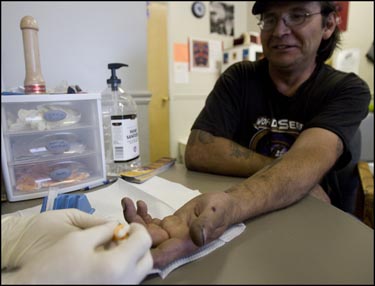
These are two interesting articles I saw this week. The first one talks about an AIDS patient cured of the HIVirus (HIV). The second is about the suggested link between gum disease and heart disease. Enjoy.
http://www.iht.com/articles/2008/11/14/healthscience/14hiv.php
http://edition.cnn.com/2008/HEALTH/conditions/11/18/dental.heart/index.html?imw=Y&iref=mpstoryemail
SOUTH AFRICA
I don't have much to write this week. I'll just say that we are battling the usual things. The new breakaway party has chosen a name—Congress of the People (COPE). They are trying hard to coalesce all opposition parties to make a strong run against the ANC. Earlier I said that I foresaw things changing in 2014 at the next presidential election, that they didn't have the numbers yet. But things changed. We will see what they will do. And if they are able to join forces with other opposition group with whom they are talking they may have a chance. Right now there are many fighting to stop Zuma's 2/3 majority.
We also had an outbreak of cholera, a water-born disease in the Gauteng (Johannesburg area) province that came from Zimbabwe.
We also had an outbreak of cholera, a water-born disease in the Gauteng (Johannesburg area) province that came from Zimbabwe.
AFRICA

For us, four things seem to dominate international relations on the continent, today: Zimbabwe's unity government, the escalating situation in eastern DRC, and Sudan's Darfur region.
Since the International criminal Court prosecutors sought to indict the president of Sudan, al-Bashir has been speaking out against the violence. Actually he has spoken out in the past, but nothing was really done; in other words, the fighting has never stopped. So people are not very expectant of the results of a declared ceasefire from the president. We wait and see.
More ominous is the situation in the DRC. If you've forgotten what's going on, let's recap. I won't go too far back in history but let's remember 1994 when the president of Rwanda and Burundi were flying in a plane that was shot down. They both died along with the French staff. This incited extremist Hutus to revolt and kill around 800,000 Tutsis and moderate Hutus (the 1994 genocide). With all the groups that are working to promote reconciliation, people are still holding on to grudges, hate, hurt, and future vengeance. It seems it's difficult for us to learn that hate begets hate; violence begets violence.
Many Tutsis left the country. Many went into the DRC. Eventually Tutsis recaptured (the current president Kagame's rebels recaptured) or reclaimed Rwanda and now most of the people running the country are Tutsis. But General Nkunda, a Tutsi rebel in the DRC also wants the DRC to be rid of the extremist Hutus (FDLR). After the genocide when the Tutsis took over again, the extremist Hutus went into the DRC. So you might ask what does this General Nkunda want? After defecting from the Congolese army, he and his Congolese Tutsi “Rebels for Christ” want the government of DRC to get rid of the extremist Hutus in the country. It was reported by the Economist that the DRC colludes with these Hutus especially in the lucrative mining business in eastern DRC in North Kiva. However, Nkunda won't rest until his demands are met and he is threatening to march all the way to Kinshasa and overthrow Kabila (the current DRC president). He wants formal talks.
And, again, a large part of the problem is the refusal of Kagame (Rwanda's president) to receive and reincorporate the Congolese Hutus as a legitimate political party in the government of Rwanda. People are still holding on to past hurts. The EU will not get involved. SADC (South African Development Community) has offered to send troops and Angola has troops nearby that may be ready. SADC has said it is ready to send troops. Something must be done and I'm glad African leaders see this as important enough to intervene without any direct interests (how Africans see the world is different as you know).
Meanwhile, one of Kagame's senior advisers, Kabuye (a former guerrilla colonel) was detained in Germany when France put out a warrant for her. They are accusing her and others of being part of the plot to blow up the aircraft of the Rwandan president in 1994. Remember that the aircraft had a French crew on board as well. All of them died. The Rwandan people (at least the ones interviewed on South African TV) seem upset. The Rwandans (well, the Tutsis in power) claim France gave support to the former president's murderous unjust government and stood by and allowed the Hutu extremists to commit genocide in 1994.
Kabuye was extradited to France (on the 19th of November), and we will see what happens from there. The hurts and accusations still go round. 250,000 are displaced due to the DRC situation and over 100,000 are cut off from aid. We are hoping to avoid another regional or continental war but it doesn't look good.
The piracy off the coast of Somalia continues with their biggest catch yet—Sirius Star, an tanker with $110 million worth of oil headed for the U.S. Now, it doesn't matter the size of the boat or the purpose of the boat. All ships are susceptible to piracy. And with even one ransom paid, the capturing pirates can live well for the rest of their lives should they not be caught in the future.
For a nice article to make you feel good about children in countries like Mauritius (please go there if you have a chance) and Namibia, read below. We do have children in Africa who are safe and sound. And some have beautiful smiles.
http://www.idahostatesman.com/apworldnews/story/577801.html
Subscribe to:
Posts (Atom)