Thursday, November 20, 2008

SOUTH AFRICA


Last week, the final year students began writing their matriculation (“matric”) exams. These exams are different than final exams in the U.S. They are separate from high school graduation. Here after finishing high school and having a ceremony (if your high school has a graduation ceremony) you write nation-wide exams in every subject you studied. You need to pass matric exams to enter university. It's a bit like the SAT or ACT in the U.S. except the students here take 2 or 3 English exams, 2 or 3 French (or any foreign language), 2 or 3 physics (or another science), 2 or 3 maths, 2 geography, etc. Students can have 10 exams or even 14 exams. They space them out and take them for about a month or so only going to school when they have an exam; otherwise they stay home as they must finish their final year early because of the matric exams (they start before final exams of Grades 11 and below).

What is special this year is that this is the first matric exams under the outcomes-based curriculum. People hate this curriculum (similar to objective-based versus marks-based) and blame it for students' general lack of competence in many subject areas. My unexperienced opinion is that whether or not it is the best system, it is probably a question of implementation. It has been poorly implemented as it requires extra care to make sure the students are competent in all content mastery topics/areas. Either way we have children that graduate and struggle to read. It's a problem. So the country waits with bated breath to see what will happen. This is the first matric exam set under the new system and we hope at least to have the same number of students pass as last year.

We're battling climate change and even future water stress (we're slated to be one of the countries hardest hit by the upcoming water shortage say around 2025, according to the World Wildlife Fund [WWF]). But the most immediate health and environment concern this month was a new virus that showed up. Four people have died from some sort of hemorrhagic fever. They died in the Joburg area. But the unknown fever has been finally named: it is a member of the arenavirus family. Originally
the National Institute for Communicable Diseases (NCID) wanted to name it after Lusaka where the first victim came from, but Zambia doesn't want the stigma attached to its capital city, so Bob Swanepoel of the NCID is going back in history to find the “putative” name. This new virus could be the result of two known arenaviruses coming together. The fifth infected person is recovering. Hopefully the virus was contained.

The former defense minister “Terror” Lekota (named Terror for his younger soccer days) has resigned from the party over the past month and started a break-off group from the ANC. He has been critical of the ANC's criticism of the courts (when judges do not rule in Zuma's favor) and of the direction of the party. He had a conference last weekend. It was amazing to see normal everyday citizens get in buses and vans and drive to be delegates in this new party forming. For the first time South Africans are beginning to see that they may one day live in a country with competitive politics, and this is exciting. They look at the U.S., and relative to what we have here, they see the race between McCain and Obama as exciting. As my lovely friend Eliza Choo (studied development/IR and has a beautiful heart for Africa; based out of NJ) suggests, political races are likes sports matches, “you like it when they are close.”

Inasmuch as this is true, then they are moving closer towards a democracy. You see the problem that plagues South Africa and the U.S. is the settling of something less than true democracy. In the U.S., the people are considered as dumb or not so intelligent by the rest of the world. Americans are told what to believe and think and they follow and listen. The ability to think, I mean to really think critically, independently is lost. So if five people want to run for president, American people focus on the two the media focus on—the Democratic and the Republican candidate. This is one of the reasons I wish there was a government fund for candidates, a fund that was minimal. Or I would even be happy with a limit. Each candidate gets two commercials that can be run throughout the campaign and no more. Debates are equally accessible to all candidates, and no petition-list barriers for third party candidates. I would love to see a race where all candidates are considered equally. Because what's missing are ideas. In the REAL world, there are more to two sides to MOST issues, yet the media does this spin doctoring thing that presents it as two sides that can never agree because that makes good TV (so they work things out in the pre-interviews for the political commentary; guess what happens if both guests want a bi-partisan solution with non-partisan rhetoric?). Democracy means everyone has a voice. It means voices, MANY voices. Is that what is in the U.S.? That's the question to ask yourself. It's especially troublesome when parties become very similar; they receive financial support from the same groups and companies. Both parties forget the same people: one focuses on the wealthiest Americans, the other on the middle-class. Both forget the guy at the bottom. One blames poverty on lack of values and wants to fight it with money for marriage and family programs. One wants to focus on social programs that temporarily help people's immediate needs. Why not both? Why not also take care of people's immediate needs while addressing the root of the problem that is causing this?

If you ever lose the multiplicity of voices, no matter if you have free and fair elections, you have lost a democracy. So South Africa sits in the same boat; although its boat is developmental or structural. There is one dominating party that dominates because it liberated not because it governs well. There is a subtle difference, but they have been riding the residual wave for 14 years. This moment was due to happen, and it is the natural course of events for such new democracies. But it's still at the point where you know which party will win. There is no surprise. There is no anticipation. It's one voice. South Africa is so dominated by one voice that opposition groups are opposing only because they are against something and not for something. This is dangerous. If you are against something you simply re-establish the notion that there is always that minority faction of discounted people, the “nu-silent minority”, the complaining company. It's expected. Therefore it is dismissed. When, instead, you offer an alternative, a viable alternative, you actually force those in power to think and question and decide what is best. At the very least, they have to answer.

So when Bekki resigned and people said it was good for democracy and I didn't see it, perhaps they were right. If they foresaw a new party forming and if they were referring to that, then it is true. It's good for democracy.


Right now there has been controversy over a letter from Bekki to Zuma. It was read last week by the ruling party's secretary who selectively quoted it making it sound like Mbeki was distancing himself from the new party. Now the letter has come out in public—Mbeki was, in fact, refusing to be involved with the ANC's run in the 2009 elections and its internal politics, implicitly defending the new breakaway party, and implicitly attacking Zuma calling the ANC a personality movement which is what ANC members accused Mbeki of leading (Mbeki referred to the Youth League's leader's comments about killing for Zuma).

So drama, drama, and more drama. My guess, judging from now, is that the breakaway party won't have enough support to win next year, but by 2014 (we vote every 5 years for presidential races) I think it will be a viable alternative. Let's hope they get a platform together about what they support.

AFRICA

Zambia had its elections after the death of President Mwanawasa. But there are accusations of fraud, corruption, and vote-buying by Banda who was the president stand-in until the election, and the deputy under Mwanawasa, and now the newly elected president.

I'm a bit glad I've lacked computer access, some free time, and updates have been deleted related to the Zimbabwe elections. If not you would have seen me say repeatedly that an accord would be reached. And each time, I would tell you that it was not and the unity-government talks have stalled over cabinet portfolio allocations. Mugabe has finally yielded the finance ministry to Tsvangirai and the MDC. But Mugabe wants at the very least to share Home Affairs; he won't concede it. Tsvangirai says without Home Affairs there is no balance in security ministries between Zanu-PF and the MDC. So we are currently at a stalemate. This week is the SADC summit, but the MDC is prepared to take it to the AU afterwards and all the way to the UN (SADC – South African Development Community, AU-African Union, UN—you should know this one—United Nations).

I know it's hard for him, too. Imagine. Mugabe is a guy you once admired and supported. Continually over the years you have had to distance yourself from him, and his group have physically beaten you badly many times. Now you win (educated guess on my part) the election. You agree to compromise and run in run-off.

Too many of your people are being beaten, killed, raped, intimidated, and vandalized. You pull out of the run-off (you wouldn't win the unfair run-off anyway). But you compromise and agree to a joint unity government.

Then in the unity government talks you are not allowed to have control of the MAJOR ministries whose mismanagement put your country in the mess it's in. People are currently dying, starving. Aid is needed and quickly. Companies and investors need to return to the country and to do this you need control of key ministries including finance, home affairs, local government, foreign affairs, etc. Which do you take? Which do you yield? What about the military and the police (local government)? Do you again compromise?

The toughest event to hit my heart is the fighting in the eastern region of Congo. It hurts for a number of reasons. It's hard to understand because it's complex. People are dying. People are being raped. People are displaced. Refugees are on the run, again. And part of it is Hutu-Tutsi fighting, again. This is why I believe so much in people who are doing Hutu-Tutsi and race-relations reconciliatory work in Uganda, Rwanda, Congo area. We need it badly.


http://www.invisiblechildren.com/news&press/news/detail.php?pID=1941921909

First, the Lord's Resistance Army (LRA) is at it again. The peace talks failed, and they were never signed months ago. Now they are again raping and killing and abducting children to be child soldiers, this time in Southern Sudan and northeastern DRC. Surprisingly, DRC local villagers are fighting back with their own local organized groups. But a bigger and older problem (for the DRC) still pervades. Over a million people have been displaced and there have been gender-based violence in rape since August 2008. Hutus and Tutsis have been fighting again. And this has been happening since the First and Second Congolese Wars (1994 and 1998).

After the First Congolese War in 1994 (60,000 civilians died), Rwanda-supported Laurent Kabila kicked out Mobuto Sese Seko (The former president of the DRC). When Kabila became president he kicked out all Rwandan military in the DRC and even fired his Rwandan chief of staff. So tension increased until Tutsi-led Rwandan and Ugandan troops backed an uprising around Goma (eastern DRC city in the valley of a volcano) called the Rally for Congolese Democracy (RDC). Kabila, in turn, recruited Hutus in anti-Tutsi retaliation leading to public lynchings in Kinshasa. And things have gotten worse since then.

The RCD, Rwandan, Ugandan, and Burundian forces took more and more of the country. So Kabila got help from Zim, Namibia, and Angola, and then reinforcements from Chad, Libya, and Sudan. With all these forces converging we had the Great African War from 1998 – 2003. This is normally why DRC people tell me there is no more fighting in DRC because this war ended in 2003. But there has been continued fighting, or let me say it has just restarted. Even with the peace agreements signed in 2008 in January (the Goma Agreement) in which 22 armed forces agreed, there have been over 200 violations according to UN monitoring groups and Amnesty International. This is because there are so many groups involved and they all have different interests and they sometimes work against each other or towards cross purposes.


You may be confused at what I just wrote about ethnic clashes and national clashes, so let me help a bit more. There are three situations going on at the same time. First is the LRA now moved into the northern and northeastern border of the DRC.


Then there is fighting between the Congolese army and Tutsi rebels (sometimes referred to as Congolese Tutsis in newspapers or journals). There is a man named General Laurent Nkunda, an evangelical Tutsi, leading this rebel group nicknamed “Rebels for Christ”. The actual name is Congres Nationale de la Defense du Pays (National Congress for the Defense of the Country). Nkunda's sacred mission is defending the honor of the Congolese Tutsi. He defected from the Congolese army in 2005 and settled in North Kivu where 23,000 have been displaced. He blames the government but eyewitness accounts have seen his own forces initiate conflict. So his Congolese Tutsi rebels are fighting with the Congolese army.

The third problem and probably the root of the fighting (related to the Congolese Tutsi rebels) is the Democratic Forces for the Liberation of Rwanda (FDLR), composed of Rwandan military and Hutu extremists responsible for the genocide in 1994 in Rwanda. Now (stay with me), twice Rwandan Tutsi forces have crossed the border to finish off the FDLR. Last year in 2007, the DRC agreed to get rid of the FDLR out of the border area, but they seem to be doing little to make it happen. The Economist reports that the FDLR and the DRC government collude to reap benefits from the mineral trade in North Kivu.


The problem with Rwanda and the previous peace talks is that there has been no component related to the FDLR. No Western forces is pressuring Rwanda to do so. The FDLR wants to be incorporated into Rwandan politics as a legitimized political party, but Rwanda refuses. A South African professor says that is the same thing as saying the status quo (with all the killing and fighting) is ok. The January peace deal only dealt with General Nkunda's rebellion. But even that peace deal failed.

The real surprise is the inability of the peace-keeping troops to do anything. The peace-keeping unit at one time increased to 17000 (the highest UN allocation anywhere in the world) but they are still unable to handle the situation. The UN has its hands full with Sudan and cannot even get all promised troops there. So more troops for this region is unlikely for the time being.

FUN WITH SCIENCE

I thought these two articles were interesting and fun, and I share them with no long commentaries.

http://www.nytimes.com/2008/11/01/arts/design/01acad.html?_r=1&oref=slogin

http://www.technologyreview.com/biomedicine/21462/page1/

ECONOMICS

All Americans in South Africa are super excited because since the rand has dropped relative to the dollar, they have more money and they get to play and have fun. I never got it. I am paid my stipend by the South African government in rand so international exchange rates don't affect me until today. My laptop adapter/charger's cord broke and I need a new one (I'm not able to solder it). When I went to look at the prices stores were charging me as much as R1 448 for an ADAPTER. I couldn't get it. I e-mailed on retail store in South Africa asking if they were sure it was what I was looking for because it should only be $30. She asked if I considered the rand/dollar exchange rate.

Oh.

Right now, it's close to twice (R10-11/$) what it was when I came (R6/$). So what helps other Americans hurts me. :D Boy oh boy!

I have refrained from talking about economics in awhile because I didn't have much to say. It started as a first world or developed world phenomenon but the way the markets are so tied together, even China's growth has slowed below double digits now. I believe it's at 9%, now. It's still growing but it's slowed, and I expect future slow-down in the future. South Africa has been lucky as we are not as integrated as other emerging countries. The big question is what happens to the emerging countries. Will they suffer?

It really depends on what you mean. Remember when you talk about emerging countries that doesn't mean all developing countries. Some developing countries are not emerging; they're stagnant or sinking (in the case of Zimbabwe). Sub-saharan Africa looks in good shape. Most of our African stock markets are not as liquid as say the New York Stock Exchange and these African stock markets are much smaller. The exceptions are Joburg and maybe Lagos and Nairobi. For Lagos and Nairobi foreign investment is small, derivatives (we'll get into this) are not common, and there is much less credit offered than in the U.S. They are also not as globalized as U.S. banks.

But they have been hit a bit (Nigerian and Kenya). Actually in Nigeria the causes started before this current crisis and is probably unrelated.

What this does mean for Africa is less money invested by foreigners. Foreign demand has decreased, and foreign aid will decrease most likely. Oil prices are dropping which hurts Nigeria but it's currency has held up well. Zambia's, on the other hand, has fallen with copper prices.

So with all that is going on, the worst affected on the continent is South Africa. It has the biggest economy and the economy most tightly linked to rest of the world outside Africa. The rand has been loosing value, about 30% of its value since September. And that's why I have to pay more for a silly adapter.


Ok, now the interesting comments. Because of the craze and turmoil and the dependence on money which helps some but not others, some wonderful innovations and creative ideas have come. Here are some.

Microfinance
My friend Neeki (golden voiced ladies man who wants to find the one with whom the magic never ends; sadly he can no longer look forward to being the first black president of the U.S. Thanks a lot, B!) often comments how strange it is that the people who have most money and the most ability to pay receive the lowest interest rates while someone who has little to no money to pay or repay receives the highest interest rates for loans. Isn't that odd? The economists among you will immediately point out that it's all about risks. Thank you. Neeki and I get it. The point is that our priority is not profit and we are not looking at it from the perspective of risk of the company or from a capitalistic perspective. We're just looking at it logically. What is a poor person supposed to do? Is it even fair? How can poor people like us get loans to help enable and empower us?


In steps Dr. Muhammad Yuunus, a economics professor who got tired of teaching “elegant theories of economics,” and 30 years ago opened up a simple bank (really a self-funded loan) loaning money to 42 people who were in debt to lenders for about $27 each. He worked to establish a lending scheme FOR THE POOR. In Bangladesh banks were reluctant to lend money to poor people because they were not creditworthy. So Dr. Yuunus would act as the guarantor. Guess what? The borrowers paid back on time. He got more members in his program, and by 1983 he opened the Grameen Bank which uses group-lending (the borrowers joins the group of borrowers in order to get money). Today they provide savings, student loans, house loans, insurance products. And it's started a revolution. There are over 3300 microfinance groups worldwide in Asia, Africa, Latin America reaching about 133 million people.

Look at the stats from the Grameen Bank. The borrowers own 96% of the equity of the bank (the government owns the rest). Almost all of the 7.54 million borrowers (it's grown!) are women. It has a 98% loan recovery rate. Over half of the borrowers are believed to have crossed the poverty line.

Now, a lot of people don't think microfinancing or microcredit will solve the worlds problems. After all, not everyone is an entrepreneur and needs money for a business; plus don't you need certain skills for business? Poor people end up competing with other poor people instead of accumulating wealth or creating jobs. These are the arguments. So The World Bank had allocated at most 1% to such programs because it is reluctant. Now they are slowly starting to invest more. We will see what becomes of it. The goal is to reach 175 million people through microfinance by 2015 the deadline for the UN Millennium Development Goals.

A Moneyless Alternative
This is what we have in Cape Town. We have a group that is trying to establish a market in which goods and services are sold and traded based on their value. A think tank for alternative economics called South African New Economics (SANE) has a suborganization called Community Exchange System (CES). At CES all products are sold for 'talents'. A talent is the measure of the worth of something. For example, a lemonade is T10, yoga classes for T30, Used Nikon Camera for T750, Humane mouse trap for T60, second hand clothes for T5, Dog walking for T20/hour, time management coaching for T100/hour. This happens on Saturday afternoons at Salt River Community House near my church. Customers are few, though.

The mantra is “what goes around comes around.” So if you have something for sale, you put an ad up. And when you need something you also put an ad up. The Transition Network is an effort to setup a similar CES in the township of Khayelitsha. The funny thing is that to setup this CES called Transition Network, outside funding is needed. So it sounds contradictory to the purpose of having a moneyless society. The hope, in the end, is that this empowers Khayelitsha to be a self-sustaining economic entity less dependent (well they say independent) on outside sources and groups for money.

A Country of Contradictions
I think we're a developing country here in South Africa. But you often here otherwise. The problem is it's really two disjoint worlds. That's why you can have people suffering miserably and at the same time others pushing us to boycott inhuman animal testing, damage to the environment, products that exploit people and violate human rights.

So the question in South Africa is this: how do you go up to a poor person who is trying to buy coffee and ask them to go online and buy fair trade coffee instead so that the cycle of exploitation of workers in Ethiopia stops? How do you do it. The U.S.? Ok, it's possible. But here, only a small minority of people have the money to do the right thing. You cannot go to a poor person and ask her to pay more money to buy organic food, fair trade food, etc. Our mayor (Cape Town—Helen Zille) said “We are not a first-world country. We cannot ask people not to buy cheap Chinese imported clothing when they are struggling to put food on the table.” [quoted in the UCT globalist] Do you see the problem? So it's something we face here.

The big question is who bears the onus for change. Some thing first-world governments should discipline rogue companies and governments. Others think even the poor would be willing to pay a bit more if they understood why.


Are the Markets Good or Bad? Do they degrade our moral character?

All of the mess of the world markets have caused a ton of writing on economics and economic philosophy in general. I love this next site which posts 13 essays answering the second question of this subsection—Do free markets erode our moral character?

http://www.templeton.org/market

Please go and check it out. I thought instead of answering the questions, go look at the wide spectrum of answers there. The one good thing out of the mess of the markets is that people have finally admitted that what we have is quite faulty. No one will say that capitalism—well some have said that capitalism is faulty. They usually use the terms free market in my readings. But with all its faults and problems and issues, the belief is that it is the best system. In other words, I think Americans believe all other systems have more faults and immoralities. So though it is not necessarily comprehensively good, it is the least faulty and we will stick with it as there are no viable alternatives. So we sit while the free world—free market economists sit back and think of a better way (see subsection above of moneyless alternatives that probably will not spread around the world. Heh heh). I am not sure they will find anything without an individual revolution (see section on World Blog Day), but we'll see what turns up.

In the meantime, what do you do with capitalism? Do you keep it and regulate it or allow it go free again? Is it fair that we put all sorts of checks and balances on presidents, the judiciary, and the legislative branches in the political context but we put no similar checks and balances on the market (well, banks) in an economic context? That's the question. And some believe, it's enough to let banks fail. Lessons are learned by other banks when they see one fall and that should be enough without regulation.

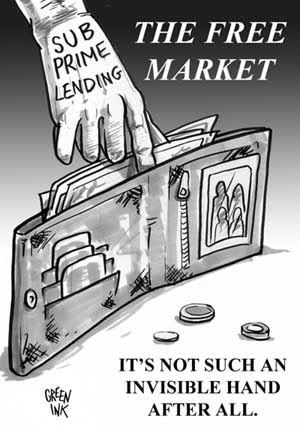
I didn't want to get into this because I thought the cause of all this was clear. I thought it was due to the subprime mortgage situation. And it is. But people want a deeper connection, and they want the full story. So, in light of that, I will do a multi-part series on an explanation of what happened with the global economic system in very simple laymen's terms, for those of us who are not economists. I do warn you that I will build. So if you miss a session, you will need to back and look up definitions in a previous one.

ECONOMICS I – TERMS and DEFINITIONS and a BRIEF SUMMARY


Ok, let's go back in time for a moment.

Well, let's stop. I was going to give you the common legend about bartering and then money being a fair arbitrary progressive step afterwards, but some historians (anthropologists and some linguists) think it apocryphal and think money existed before bartering in some societies. But I will tell it anyway because I think the order of bartering and then money did happen in some societies.

I've talked about the progression from agrarian societies in the context of African history. But the process usually goes like this. When we left the stone age to go to the iron age, the farming tools were so much better, stronger, more efficient, that there was more time. More time to prepare food, more time to hunt for food, more time to specialize. If you have more time to specialize you can make better tools, better dwellings, better anything. As people began to specialize, there was a need to use products of other people. Let's put it in our terms.

I am the shoe maker and you are the chicken farmer. You come to me because your new born baby (your first child) needs tiny shoes. I make them for 30 eggs. We trade. After 3 days (I have a large family) I need more eggs. I go to you, but you tell me you don't need any more shoes. WHAT! What do I do. So I go to roof maker and offer him some shoes. He only needs a pair for his wife. I ask him to repair your roof so I can get more eggs from you. He agrees and you get your eggs, but you see the problem with bartering. Different products are needed at different rates and for different lengths. Not only that but how do you rate services when they enter the picture later. Bartering became impractical. We need a fair tool to use to buy and sell to trade goods and service. Enter money.

The problem, today, is that macrofinance (a subset of economics) is ridiculously complex that most people don't understand it (including me). The wonderful thing about being a teacher is that you can test out macroeconomics on a small scale and see it work with students—inflation, supply and demand and price change, etc. This especially works for games in behavioral economics. But you have to tie people's concerns into real goals. You must tell the kids that if they live and survive the fake game, they will receive actual cash, double what they have at the end (get some funding for this). That makes it real and they really fight to stay alive, to keep their business open, to keep buying food at the end of the day. The store owners actually raise their prices at the end of the day when they realize more people want their food.

I wish we could try some of these exercises with 10 people to show how it works. I had a conversation the other day with a guy who believed there was no actual methodological basis for the beginning of inflation. He can see how it is perpetuated but he cannot see how it starts. This is what I mean. So let's get started and define some terms so we can begin to understand in a basic sense what happened.

Money - what is offered or received for the purchase or sale of goods and services

Liquidity - Market liquidity is a business or economics term that refers to the ability to quickly buy or sell a particular item without causing a significant movement in the price. The term is usually shortened to liquidity. (so if you don't want a refrigerator anymore, and you cannot quickly sell it and get rid of it, it's not very liquid if you get my meaning; liquid things are things you can change into cash really quickly)

Commercial Bank (this is a bit harder but you use them) – financial middle-man/institution (can be private or state) that takes credit from lenders (when you put money in the bank, economists say the bank is BORROWING money from YOU, the LENDER) in the form of cash deposits and that lends money in the form of loans. So a bank takes deposits from people and gives out loans to people. It makes it money by holding a portfolio of securities (portfolio just means all the things you've invested in, like a folder in school when I ask “what are all the subjects you've invested time studying”--you open your folder and show me). in other words, a bank makes money by investing the money you give it. When you loan the bank money (when you deposit money in the bank) through a savings account the bank give you a low interest rate, but takes your money and invests it to make money for itself at a higher interest rate. Some of the money it must pay back to you (it's borrowing the money so you get interest). But since it earned a higher rate, in the end it has made money.

Securities – (economists call them instruments) financial instruments like stocks, bonds, mortgages, notes, etc. Let me explain “instrument”. An instrument allows the holder to claim ownership in a corporation (a stock does this), or allows a creditor (someone who gives credit—this means lends money) relationship to a company/government/agency (a bond does this; if you buy a bond you are lending money to the government; the bond is an instrument that says you have a lending relationship with the government and the government will pay you back plus some interest) So all of these types of securities are things that commercial banks invest in to make money using your money. Bonds give fixed returns, shares (stocks) give variable return.

Stocks – (shares or equity) ownership in the company (if you own a share or a stock, you own a percentage of the company)

Bonds – A fixed interest IOU from the government or an agency. For lending the gov/agency money (buying the bond) they promise to pay you back plus the fixed interest (that won't change)

Investment Bank – (primary difference between a commercial bank and an investment bank is that a commercial bank makes money by issuing loans from its pool of deposits [and invests money, too] while an investment bank brings both debt and equity to the market for a fee) a bank that issues securities, run markets for previously issued securities (so run markets for buying and selling of securities), maintains broker/dealer operations (brokers sell and buy securities for a client, dealers due it for a company using company money), advises investors, and handles corporate mergers (two companies joining) and acquisitions (one company taking over another or buying another), corporate restructuring, and private equity placements (selling of new equity/shares). Whew! Investment banks do not work with individuals. That's why you don't see them.

economic vehicle – a fund or joint venture (two individuals or companies join together to share risk and profits—think of any partnership) that generates a lot of cash flow

Collaterized Debt Obligations (CDO's) – it's an investment security that is backed by (the money is invested in) a pool of bonds, loans, and other assets. They are unregulated, and usually a hodge-podge of debt and credit but are usually non-mortgage loans or bonds

*********
*NOTES*
Debt and credit are the same thing. In a transaction, one person sees the flow of money as credit, the other sees it as debt.
Banks operate on the premise that not everyone will request their money from me at the same time. If that were possible, then banks couldn't take your money and invest it; they would have to keep it because everyone could ask for their money all at once and leave it with $0. So the higher percentage of its assets a bank plays with, the more risky we label its actions. If a bank invests 50% of its money (assuming that on any given day only 15% of the money will be asked for) then we say it is acting less risky than a bank that invests 65% of its money (also assuming that only 15% of the money will be asked for). If a situation ever arose where everyone wanted its money back, a bank would fail.
the way things work in economics, the higher the risk, the higher the yield (the return, the money you make). It's not just economic law, it works in all areas of life. If you want to run a marathon in 2.5 hours (high yield or return) you have to put a LOT of work to get there (high investment). The same thing works in money. Usually crazy risky ventures and ideas cost a lot of money to get going and working, but they will also produce a lot of money. On the other side, the government is usually good for it's money (remember the government, say of the U.S., does not have to balance its budget like most U.S. State constitutions require) so you can buy a cheap bond and get a LOW return (the government pays you back only a little extra for borrowing your money [giving you a bond]). IF something were very risky but low-yielding, it would not make sense to invest because you could always find low-risk low-yield securities instead.
Oh one more thing, the Federal Reserve bank is the top bank in the US, the central bank for the country. they also do not interact with people, but they lend money to banks. They also set their own interest rates and this is usually what you hear in the news. But they are not setting the interest rate that your commercial bank charges you. They are setting the interest rate they charge to lend money. But it's a chain reaction. If a bank borrows money from the Fed at 1.7%, they will charge you a higher percentage to borrow money from itself. That's why the Fed's rate matters. It trickles down to you. Just like the Retailer (your shopping store) adds more money to the computer or chair or shirt they buy from the manufacturer so they make money, so the bank charges you a higher interest rate to make some money.


Ok, let's get started with part one. It all started eight years ago. I hate saying that because it sounds like I'm blaming the Bush regime, but all I've read says that. During the 90's during Clinton's administration we had a huge boom and by 2000 we were sitting in quite an amazing position as the lone superpower, admired by most and loved by many.

The global economy had been growing at this point, but returns were low. This was because the interest rate was low. (This is where greed sets it) The bottom line in this system is to maximize profits. And if there is a way, people will find it. So to get higher returns, investment banks came up with investment packages. Some of the packages were vehicles like CDO's. The point of the package is to spread risk around. Remember CDO's are a mix of credit/debt securities. So if there is bad debt out there and say biotech bonds go bust, you are not hurt as bad because you have a nice mix. Person A gets hurt a little, Person B gets hurt a little, Person C gets hurt a little. You get it?

But the debt packages hurt us in the end. Instead of protecting banks, they spread bad debt everywhere to everyone. These packages had been combined and bundled up and sold and re-sold (so now Joe Shoemakers loan is in several different places across the country) it was difficult to rate how much bad debt was carried. It's like eating a a dessert and asking where it came from. Well, it was Tres Leches so it uses three type of milk; one was imported from Canada, another from China, and another from the U.S. But the U.S. milk came from a goat that was brought to the US from Pakistan to breed with a US species, and that goat is actually not indigenous to Pakistan. . . not to mention all the other ingredients. So it's difficult to tell how much of the dessert came from US products (I didn't get to the eggs, sugar, vanilla extract, etc.). That was the problem. Moody's and Standard & Poor's usually help traders by rating bad debt.

So in this new era, the system was not ready. The sub-prime mortgage crisis hit. Many homeowners in the U.S. defaulted on mortgages. They did not have the money to pay it back after mortgage companies went through a period of excessive predatory lending with (this is key) LOW interest rates (this is why companies normally give high interest rates to people with less money [still doesn't make sense in my head]). Now the sub-prime crisis showed how much bad debt people really had. It was EVERYWHERE! Banks started writing off billions of bad debt (write off means you call it a loss; you realize you are not getting that money back; write it as a loss and go on). Share prices started falling. Banks values dropped.

Are we ok so far? We're almost there.


The last thing to know is that all of this crisis came about because people overhyped, oversold, overbought, overtraded nothing—like thin air. It's the way investment banks work. How much you do it is what makes some people call you reckless. Investment banks (the biggest ones) depend on trading vastly more money than they actually have in assets. To do this trading, they get short-term loans that are (key) EASILY extended to them. Faith can move mountains, and in this case it makes a way for investment banks to always get the money they need and ensure that they can make up losses with future trading (so if I didn't make money today, it's ok; I'll just borrow some money and trade some more tomorrow with money that's not mine, and it will be fine and I'll make up the money I lost). Can you begin to see the problem?

So word spreads or fears spread that bad debt is spread further and deeper than people realize. What happens? (Earlier we spoke of banks not wanting to lend poorer people money; if they do they give high interest rates because they see it as a risk, but below a certain point they do not) Banks were more hesitant and cautious in lending money to other banks. If you are an investment bank and you can't borrow money to make money even though you are buying and trading with borrowed money (not real money) you're in trouble. This was a type of death sentence for banks like Bear Stearns and Lehman Brothers. So doubts began to grow about the solvency of banks. This caused share prices to plummet (even if doubts or beliefs are not true; it (even if artificially) changes price because price is ONLY based on what you believe; If I have a prize winning cow but everyone thinks she has cow's disease I cannot sell her for lots of money because of this FALSE belief. I must lower my price. If people think your bank has a lot bought a lot of debt that will not recover and now that same bank is not able to get money to borrow to trade, then you might want to pull your money out. And you might want to do it NOW! If you wait until it fails, you have lost your money). When share prices fell, normally banks could build up its assets through daily trading, but no one wants to loan money to a bank that is about to die (whether true or not). So watch this. If people think a bank is going to fail, the withdraw money. If you withdraw money you cause it to fail. Do you see how it works? So the rumors grew until they became a reality.

(UCT Globalist listing)
Bear Stearns—one of world's biggest independent investment banks. Collapsed in March, acquired by JP Morgan Chase in May 2008
Lehman Brothers filed for bankruptcy in September 2008; 1 of 5 largest independent investment banks

Fannie Mae (Federal National Mortgage Association) – created in 1938 to provide easier housing loans in the post-Depression years. Publicly traded company, it's backed by loans in secondary (ask later) mortgage industry, Government took over (and took over Freddi Mac) this year

Freddie Mac (Federal Home Loan Mortgage Corporation) – created in 1970's as a competitor for Fannie Mae in 2ndary mortgage industry

American International Group (AGI) – one of world's largest insurance firms, bailed out by Federal Bank of New York in September 2008 after suffering liquidity crisis

Bank of America(BoA) – U.S.'s largest commercial bank after acquiring Merrill Lynch (largest financial services firm in the world)

Merrill Lynch – large independent investment bank that was sold to BoA in September 2008

JP Morgan Chase – one of oldest traditional bank holdings companies in the world. Purchased Bear Stearns in May 2008

Goldman Sachs & Morgan Stanley – the 2 largest investment banks in world; due to recent market developments, changed their status to bank holding companies in order to be eligible for emergency government funding


I probably did assume some things so if you have questions feel free to ask or to ask me to put it in the next one. I think we'll look at a few specific examples next time.

ARTS


My choir had their semester concert. It wasn't amazing, but it was a good start for the choir. I started getting bored with rehearsals after awhile. I tried but the boredom didn't start. Our songs are repetitive and we don't do anything to provide movement within the song (have a dynamic soloists, change keys, since a different section) for some many of the songs. It was nice that they invited a poet to fill bridge sections in two songs. That helped so much for those two songs. We didn't get an amazing turnout but for those that came they received a 1 hour concert and a full amazing meal for only R15-20! I ended up playing piano for the choir and did not sing because they needed a pianist. The temporary director made us play two songs when we were not prepared to do so. So we just messed around. It was ok. There was a marimba group that did an amazing job and they invited a music producer who was in town to play and he could really play the piano.

Two weekends ago I went to the Khayelitsha (a Cape Town township) Festival. It was great because it was the first of its kind and all the people with booths owned or ran Khayelitsha businesses or non-profits. There were no outside organizations (well almost none). It was amazing! I was really proud of them. They will judge how it went and decide whether or not to make it an annual event. I hope they include other townships and make it bigger because they all need the promotion and economic boost!


Before the Rains
Excellent movie for me. It's a suspense drama that deals with a white project manager
working in India in the 1930's who falls in love with his Indian domestic worker. Both of them are married. And what ensues is at the intersection of justice, honor, pride, shame, love, and culture. I hope it was not a true story. It's a bit sad, but good. I did not recognize any of the actors.

Choke
I don't recommend you see this. It's quite explicit. I stumbled in on this and didn't know what the movie was about. I think parts of explicit nature come about because the main characters have a severe sexual addiction and attend a support group for it, like NA or AA, but probably called SA? I'm not sure of the name. Anyway, the part I liked in the movie is the best friend who began a project in his community building something. And through the building

Oh the coolest thing with the arts these past 3-4 weeks was that there was a conference in Johannesburg about 4 weeks ago which included T. D. Jakes and Paula White. They had musical guests like Mary Mary, Yolanda Adams, Fred Hammond, and Israel Houghton. Well, Israel has some special link with Hillsong, so he came to Hillsong Cape Town the following week and did some music. I thought he was just going to lead the musical worship but they actually had him do a 1-hr musical set in place of the sermon and then added a short sermon (5-10 minutes). It was sooo good. I love Israel's music; he's one of a handful of minority (black kid [mixed] adopted by a white family who went to a Hispanic church he says) Christian songwriters whose songs are played in churches of all ethnicities. And that's a beautiful thing. Plus he really has a gospel base to his music and with his choir. I really miss that sound. I haven't come across anything as soulful as African-American gospel music. The power to emote is unbelievable.

People in South Africa have great voices according to Americans. They do. I think they are judging by an American aesthetic, though. South Africans are the Africans that to me sound the most like Americans when they sing. They even have a very similar vibrato. But when you travel to other places, the singing and vibrato style is more of a separate identity from the U.S., so much so that when I've seen African singers (who would be considered good in African countries other than South Africa) on American Idol, they are placed on the first show where people laugh at how bad they sound. It's a different idea of beauty, a different way to make vibrato, a different way of singing. But here they sound very much like they are leaning towards African-American gospel style. Because of this people think they sing really well which they do. But to me it's just an American influenced style.

But I love that style. And it was nice to have Israel and to hear that kind of music again. I miss it. We're trying to get my church more diverse. We'll see.

U.S. ELECTIONS


It was a usual morning that day except I knew that my mother was also coming to school to attend the 8th grade assembly, an end-of-the-year assembly to say thanks and goodbye to us before we left to high school. It also included end-of-the-year awards. I was ushered to the front to sit on the stage just like my teachers told me the day before. Apparently all nominees for the Johnston Award had to be on stage. All other awards just called up the winner.
The Johnston Award is like a holistic valedictorian award. Grades are a criteria but it's really holistic in terms of everything—service, attitude, grades, reaching-out, character, aspirations, etc. To tell the truth, I'm not really sure of all it entails. I just thought it was mostly about grades. And so I thought Aaron Yeoman was going to win it.

We all thought that.

My middle school, at the time, was majority white, but had a large non-white population. My guess it was a small majority of about 60% or so. But all non-whites thought it would go to a European-American person. And even if it didn't, why would the African-Americans be excited about an oreo being up there like me? That's what they called me anyway.

So when they announced all the winners, I wasn't particularly excited or nervous. I thought maybe this other kid might have a chance and beat Aaron, but it would probably be Aaron. But something strange happened, very strange.

After announcing the nominees for this final award and explaining what it is based on (I wasn't listening), they announced that I had won the award. That's not the strange part. The strange part was what happened next. The entire auditorium erupted in pandemonium. People were screaming, yelling, hooting, hollering, clapping, dancing. The place had to be quieted down. It was like we were at a sports event. And then I realized it. It was about more than me. People could NOT believe that an African-American had won the award. It was inconceivable. It was also the first time in the history of that school that it had happened.

Aaron Yeoman was outraged and incensed. He stormed off the stage. My mother found me, and at that time in my life, was quite happy with me and proud of me. There was a nice innocence there. I just smiled surprised. All the kids who called me oreo came up to me and congratulated me. I may have been an oreo but I was there oreo and they could take a bite any time they wanted (I don't know what that means).

My mom hugged me and said nice words as I boarded the buses for our 8th-grade ranch day (same day as the assembly) at Regal Ranch where we would play games, eat lunch, ride horses, canoe, etc. And throughout the day people would continue to congratulate me.

I even remember the following week after that (we still had a few more days of school in which we did nothing). Aaron Yeoman said audibly and loudly, standing right next to me, how it was completely wrong—a mistake. He began to list the reasons why he should have won the award (He has won more science fairs than me [he's right I have never one a science fair on any level], he has won the history fair [he's right, I have never won a history fair on any level], he has higher grades than me, he smarter than me. . .) I remember thinking, “Wow, he is mad.” I told my best friend Jose-Miguel about it at the time. It was a bit crazy to hear him say that, but I wasn't mad at him. I just found it interesting. When I looked at it, I think most of the stuff he said was right. And then Ms. Young (she was a pretty Chinese American teacher who taught history) came up to me and told me she had voted for me or chose me or fought for me (it's not a popular vote; the teachers decide). She assured me I was the best person to win because it's not about grades; it's the total person. I never got that day or what it meant to so many people.

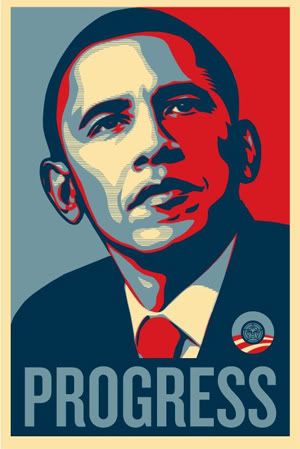
Wednesday morning news saw no murders, no rapes, no high-profile court cases, no political party drama, no international tragic sagas in the DRC and Zimbabwe. There was only one thing going on in the news. The biggest news in Africa and South Africa is not just the US election, but Barak Obama. I can imagine a small bit of what he must be feeling though his situation is on a much grander and important scale before the whole world.

So when I received a newsletter from a pastor of a church in Texas that I used to play for, I wasn't surprised. It was Aaron Yeoman speaking in a subtle. You see in churches where I grew up, Christians are supposed to be Republican (my home churches were usually white-dominant Southern Protestant churches). This was evident to me because leaders would make comments in services or in prayers that show Republican support. I thought it was strange because I thought you could be a Christian and support any party supposedly. So I was familiar with the hidden, subtle sentiment in this e-newsletter. I wanted to paste it so you don't take my words for it, but it doesn't allow me to copy the words from the e-image.

The letter starts by saying the mission of Christ is the same no matter the elections.
It then says that the pastor is the pastor of a multi-ethnic, multicultural group [it's majority white].
This is followed by 3 cautions.
1These times can surface ungodly attitudes like anger, resentment, pride, or arrogance. Be careful that you don't forget or miss the deeper things God is doing in the short term.
2We're supposed to have checks and balances, but since one party holds most of the power, there is a danger and we need to be on moral watch for abortions, pornography, same sex marriage, and safety from terrorists.
3Any media coverage that only gives one side and instigates fear is wrong. The Lord is the one who brings people down and puts people up. But we live in a new time were people “go after” each other. We should insist in objective, unemotional coverage.
This is followed by four ways to pray after quoting the Apostle Paul from 1 Timothy 2:2,3.
1Wisdom to lead in ways that provide conducive atmosphere for sharing the Good News
2God gives us wisdom to stand/speak for unborn, elderly, and marginalized
3That spiritual voices and leaders are raised up to sound call for holiness, righteousness, and justice because our answer is not in the Oval Office but in the Throne Room of Heaven
4An outpouring of God's spirit and grace on the nation so that an unprecedented number of souls come to God and cities and lives are transformed and the church makes a difference

I won't comment much on it only that caution 2 is what is called selective moralism (and it's not good) and caution 3 strikes me as funny because the same church and pastor did not care at all or sound a caution when a different party controlled the Houses a number of years ago. So it doesn't seem like a true impartial concern for balance. I'll stop there though there are other points. I'm a bit used to it in Texas.

I'm dumbfounded and cannot understand how an Obama election win happened. How did he come to be in this position for such a time as this? It's quite amazing. I wish his maternal grandmother could have seen this day.

I just stood in front of the TV and cried. It's quite emotional because it means so much to so may who are not even Americans.

An African can have a child who can become the President of the United States.
A Muslim can have a step-child or child who can become the President of the United States.
An African-American person can have a child who can become the President of the United States.
An African-American can become the President of the United States.

Who knows? You may have been born for such a time as this.

Those words keep ringing in my head. They are said by an Ancient Persian government official who was actual Jewish as he was speaking to his niece who was to save the Jews that year.

It's a bit difficult to explain what is happening the world round. People are rejoicing; they are seriously rejoicing. I believe the only reason I got my visa today was because Barak Obama won and I am an American.


You see people judge you by your leader. I'm not lying. I often have wondered what it must be like for Bush to read international (and these day U.S.) papers and newspapers and magazines that talk about his failed policies or his administration's failures. How does it make him feel? Does it sink in or bother him at all? Do you hold on to your guns and intuition and feel your administration did all that was right while people say the opposite the world over? I wonder if it affects him. Does it affect his identity?

At some point you have to sit and say, maybe what others say about me has truth. Or maybe they are saying it for a reason. So if the world is saying the U.S. is acting in a certain way that is negative towards the world community perhaps we should at least consider the possibility. It can't be that we have the only clear sight. Plus if one is acting in a bad manner, it takes friends (and sometimes enemies) to help because one wouldn't know it. Usually if you thought you were wrong, you wouldn't do it (most people). You act in a way you think and believe is right.

One thing the world says is that the decision between Obama and McCain is simple. This is hard for Americans to understand. South Africans tell me that Obama won by a landslide. I don't really think so; they are looking at the electoral college, and I don't say anything to them because I don't mind them thinking that. It gives them a certain opinion about us (that works both ways, people felt a certain way about all American people even though Bush's election results were close). But when you look at the popular vote, you see it is much closer. But now, people are saying, “Ok, maybe the American people do see that things were messed up and that things were bad.” “I can breathe a sigh of relief. If they had voted otherwise, I would think that what we feel is not anti-Bushism; it's anti-Americanism.” “It's interesting. Gordon Brown is very technical and precise when he speaks, though not motivational. Obama is super inspirational and motivational. But Bush seems to be neither. It's strange. It's weird to see a world leader who has no real ability to convey himself in a good understandable manner. And what can you say about the kind of people that would elect Bush to two terms? I can understand possibly one term (maybe), but two?” These are real comments people tell me.

For us as a people the decision was hard and it was a close battle, but for the world as continents (Africa, Europe, Asia, Latin American, Australia), he would have won by a landslide.

Take a look at the “global electoral college”.
http://www.economist.com/vote2008/

I thought he would win ever since he was running in the presidential Democratic race, but I couldn't say that to people that questioned me for a true prediction. In that case you make a conservative guess or a conservative estimate. You don't want to be wrong for people who depend on what you say. But interestingly, since I made some predictions earlier, so many things had changed (McCain moving more right, McCain choosing Palin, many Republicans endorsing Obama including Colin Powell whose words were quite powerfully put, etc.). Honestly both men could have governed well though it is debatable to some (it depends on what you consider good governance).

I don't really know what to say. How in the world did this man capture the hopes and dreams of the entire WORLD?


He has been compared to Mandela, to Nkrumah—in Africa—to Martin King Jr. He is celebrated the world over and he hasn't even done anything yet. It's amazing and hard to understand and fathom. But it does make me feel like we can come together, like we can work on results-oriented solutions outside of Dem vs Repub. I just want to fix up the country and I want to work to do it. He's inspiring.

Every country here wants to work with this man. I almost feel like guys like Hugo Chavez and Evo Morales might give us (the U.S.) back our ambassadors in their countries (they kicked out ambassadors recently and then the U.S. did the same in suit; Honduras has postponed the receipt of a new U.S. ambassador). Maybe no more troops have to die in Iraq. Maybe we can negotiate with Iran. Maybe Iran won't be so after us. Maybe African despots will have more respect for him (well they do; I don't know if you call Kibaki one, but he was elated and Kenya got a national holiday).

You see, one problem with the current administration is the reaction it has received. Many people hate the U.S. president. I'm speaking of people in the U.S. They paint him as completely evil. This, of course, is nonsense. Granted, I have had many hours where I have tried to understand the logic of what is happening in the country, but then I realize it is always about priorities (go back and read the blog or e-mail section about how priorities [not direct cares/concerns] form people's socio-political leanings). Bush is not evil or completely evil. He is not trying to harm people. He does not hate the developing world, citizens in Iraq and Iran, South America, the UN, poor people and the lower classes in the US, the environment, children in poverty in the US, Europe, Asia, etc. He has certain priorities. But here is the problem. The same mistake that people make in painting him one color is the exact mistake he gladly makes with countries around the world. When you call countries like Venezuela part of an Axis of Evil and call leaders and countries evil, that is nonsense. Leaders and countries have interests just like the U.S. It's difficult to find people that are all or completely evil. But when you paint your country as completely good and right and just and other countries as completely evil and wrong and unjust you put the wrong message in the minds of your own citizens who unknowingly follow you and in the minds of the people of the world. It's just not true. It makes complete sense why Chavez would then resort to name calling and paint the U.S. or Bush as one color—white devil or whatever comments he makes. It's tit for tat.

Never deceive yourself into thinking you are always right and you are on the side of justice. You must always be vigilant to guard yourself and examine your actions and thoughts especially input from others (people outside yourself). This works on a national scale. With Obama there is a chance to start on a clean slate. As I listened to the close of his speech election night (we didn't get to hear most of it), one thing struck me as odd in an exciting way: he said “God bless America.”

Why?

Well, after 9/11 I heard it, saw it, and read it everywhere I went. God bless America. God bless America. Bush said it. Country singers sang it. It was on bumper stickers. Was it me or did anyone else really heard a different message through it all. It wasn't truly “God bless America.” It was more like “God bless us because we're the best” or “God, help us to crush and kill our enemies” or “God make us great to the exclusion of others.” I'm not lying, you could see it was used not as a statement of the desire to follow God but as a battle cry as a motivation to do harm to others for vengeance. It was filled with xenophobia and jingoism. Anytime you speak from a jingoistic standpoint you can be sure you've missed the mark.

But here, in Chicago, on this cold night as he spoke those words acknowledging all the people around the world believing in him, it means something different. It reminded me of the Ancient Judeo-Christian tradition of a man (who is also considered to have been the father of the ancestral line founding Islam) – Abraham. And he had a covenant with God in which God promised to bless him, but it wasn't so that Abraham's family and name would be mighty or so that he could crush his enemies or so that he would be the best in the world to the exclusion of others. It wasn't a battle cry and it wasn't reactionary. God told him that he would bless Abraham to BE A BLESSING.

Interesting concept. But I can see it in this moment. It's as if America has been blessed (who can deny it) beyond any regime or government in any place in any time in the history of man. And people around the world our looking toward us for hope for help for love for the bond of humanity. We have broken that numerous times in the past but especially openly, consciously, and hurtfully within recent years even to our own Americans (look at all the money diverted away from just programs for children in poverty toward the war; today 1 in 6 kids lives in poverty in the U.S. and we lost ground over the past years). When Obama acknowledged those who didn't vote for him, when he acknowledged those of us around the world in palaces or huddled around radios, he gave us hope. And we feel like “God bless America” means what it was supposed to mean—God bless America so that it may bless others. Don't bless it as an end itself. Bless America to be a blessing. That's who America was. That's who America is.

With every comment here I felt the weight on his shoulders increase even through all the cheers and smiles. He has huge expectations. And let's be honest. There will be some mistakes along the way. It's a bumpy road ahead and he has inherited problems he didn't cause, but I would like to help do my part to resolve them. He probably cannot meet the expectations of everyone, and all analysts and journalist make it clear (you don't know how many articles I've seen here that tell South Africans that Obama is an American elected by Americans to protect American interests). We get it. Thanks for reminding us, and I'm sure he will tell us, too. But remember two things. One, even if he does very little, he has ALREADY done much just by being in the job and getting tot his position. It means something has changed most importantly the American people. Secondly, just by being in this position it makes it easier to work with people who did NOT want to work with the current administration, would not talk to us (or we would not talk to them), flatly discontinued relations, or continue wrongs to their people but could not stop to be swayed by the current administration. This is without any work. With work, more is possible.

Everyone looks up and admires the U.S.

I've heard more comments like that as well. It's as if the one election has reversed some of the past 8 years already. My goodness. My goodness. CNN reporters crying. Me crying.

The reason the next president means so much to the rest of the world is because we are affected by it in so many ways. One of the biggest for us in the developing world is aid. Right now there are strings attached to PEPFAR (US President's Emergency Plan for AIDS Relief) aid that was in the Bush plan. It cannot be related to condoms and you cannot use it for prostitutes. But what if the prostitute is a 12 year old girl who was forced to do it? It doesn't matter. So some people here don't like these strings and therefore don't like Bush for putting morality on the AID. Some think condoms are not an issue of morality; we just need it here in South Africa and elsewhere. And you can attack all areas of the ABC (abstinence, Be faithful [attack the sexual networks], use a condom [educate and distribute especially for married women who get it from unfaithful husbands and vice versa] and still work on the A (abstinence). They aren't mutually exclusive. But Bush has done much for Africa even if it was after a lot of encouragement and coaxing. It will be quite difficult for Obama to match the aid promised by Bush in the current financial storm.

You know my father always wanted to be in politics. He's ineligible to run for president but it means his children could one day be the president. My good friend Neeki wanted to be the first black president. That's over, but it does mean one day he could be the second black president (hopefully after the first woman president).

More importantly, it means there is a new direction and change coming for ALL of us, regardless of party or affiliation. I honestly think he is the person to do that. People said he is inexperienced but perhaps the experience needed for the job of winning the election was the organization work he did in Chicago. People said he is young. Perhaps the perspective needed to win this election was from a young person. He held his own in the debates. He actually does have policy (people always say he doesn't) and you can study. Perhaps he can. . .perhaps he can. . .more importantly, we can. . .and we will.